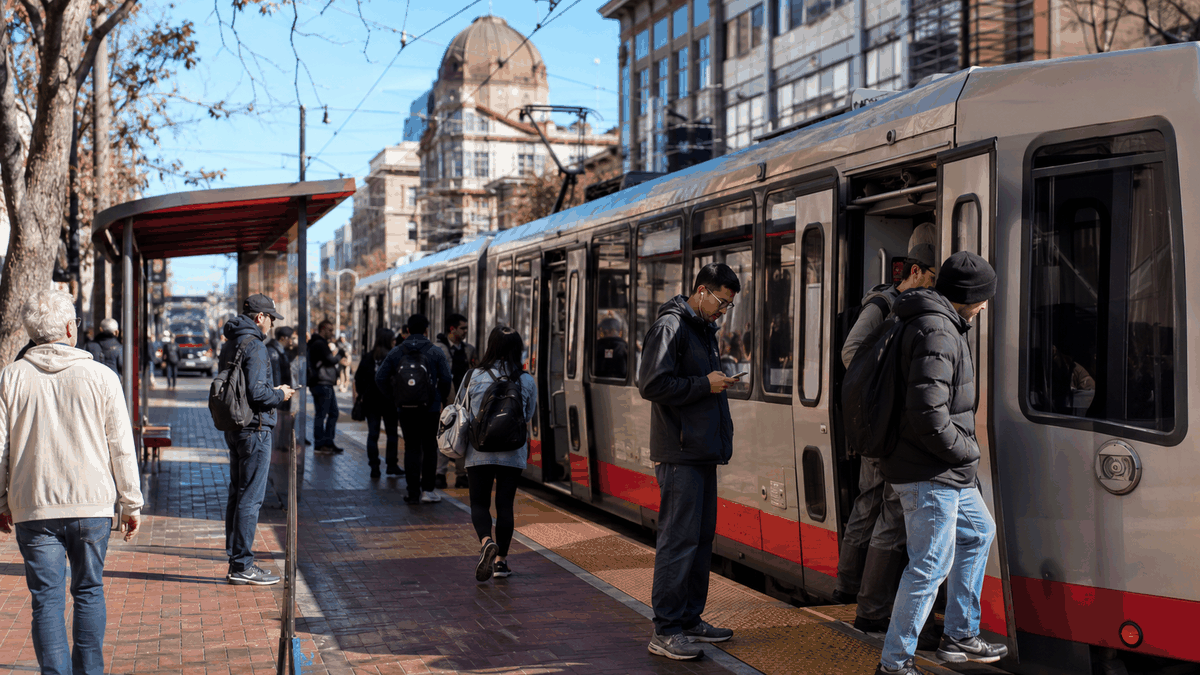
San Francisco Muni riders will see a new set of service changes beginning Saturday, Aug. 29, affecting 12 routes across the city.
But riders should not read “service changes” as meaning every one of those routes is simply getting more frequent.
Only a couple of lines receive straightforward frequency increases. Others get larger buses, more capacity at particular times of day, school-focused routing changes or revised schedules.
The 12 Muni routes changing Aug. 29
| Route | What changes Aug. 29 |
|---|---|
| K Ingleside | School-related service adjustments |
| N Judah | Peak frequency improves from about 10 to 9 minutes |
| 1 California | Frequency improves from about 10 to 9 minutes |
| 5R Fulton Rapid | Every trip shifts to a 60-foot articulated bus; frequency remains about 10 minutes |
| 8AX Bayshore A Express | Some morning trips change to create a one-seat school trip |
| 22 Fillmore | Additional capacity |
| 28R 19th Avenue Rapid | Adds a stop at 19th Avenue & Eucalyptus Drive |
| 29 Sunset | Additional capacity, including evening service |
| 37 Corbett | School-related service adjustments |
| 38R Geary Rapid | Additional morning peak capacity |
| 49 Van Ness/Mission | Additional morning peak capacity |
| 66 Quintara | School-related service adjustments |
There is also a timetable adjustment for 22 Fillmore Owl service, which continues to operate every 30 minutes overnight. SFMTA's full Aug. 29 notice is the primary source for the changes below.
1 California will come a little more often
The 1 California is one of the easiest changes to understand. Buses are scheduled to arrive approximately every 9 minutes instead of every 10 minutes.
Where service overlaps between the Presidio and downtown portions of the route, SFMTA says riders can effectively see service roughly every four to five minutes.
N Judah peak service improves to every 9 minutes
The N Judah also moves from approximately 10-minute peak service to 9-minute service. SFMTA is also making operational changes intended to reduce congestion around the La Playa terminal, where trains can stack up and delays can spread back through the line.
5R Fulton Rapid gets bigger buses, not more buses
The 5R Fulton Rapid is a good example of why the Aug. 29 package needs a little explanation. Its scheduled frequency remains roughly every 10 minutes.
What changes is the vehicle: SFMTA plans to operate 60-foot articulated buses on every 5R trip, replacing the current mix of 40- and 60-foot buses. The bus may arrive at roughly the same time as before; it should simply carry more people.
38R and 49 get more room during the morning rush
The 38R Geary Rapid gets additional capacity during the morning peak. The 49 Van Ness/Mission also receives additional morning-peak capacity.
These are targeted crowding changes rather than all-day frequency increases.
29 Sunset gets additional capacity, including evenings
The 29 Sunset is also scheduled for additional capacity, including in the evening. Because the 29 is a long cross-city route serving schools, neighborhoods and major transfer points, the change reaches well beyond the traditional downtown commute.
School trips are a major part of the changes
SFMTA says about 27% of SFUSD students rely on Muni to travel to and from school and nearly half of high-school students ride transit. Several Aug. 29 adjustments are designed specifically around school travel.
8AX: a one-seat ride toward Francisco Middle School
A small number of morning 8AX Bayshore A Express trips will begin serving regular 8 Bayshore stops north of Broadway. SFMTA says that creates a direct trip for some riders traveling from Visitacion Valley toward Francisco Middle School instead of requiring a transfer.
28R adds a Lowell High School stop
The 28R 19th Avenue Rapid adds a stop at 19th Avenue & Eucalyptus Drive, intended to improve access to Lowell High School.
Hoover and Rooftop
Students traveling to Hoover Middle School use regular 66 Quintara service and its normal stops. Students traveling to Rooftop School use regular 37 Corbett service.
Aptos Middle School: K Ingleside to the 8 Bayshore
For Aptos Middle School, SFMTA lays out a specific connection: take the K Ingleside westbound to the Ocean Avenue/CCSF Pedestrian Bridge stop, then board the 8 Bayshore at Geneva Avenue & Howth Street.
What is happening to the 22 Fillmore Owl?
The overnight 22 Fillmore Owl is not being cut, and it is not becoming more frequent. It continues roughly every 30 minutes between midnight and 5 a.m.
What changes is the timetable. SFMTA is adjusting scheduled times so they more closely reflect how long overnight trips actually take.
Why is Muni making these changes?
SFMTA describes the package as cost-neutral: vehicles and schedules are being reallocated and capacity targeted rather than a large amount of new operating service being added systemwide.
That constraint matters because the agency continues to face a serious long-term budget problem. SFMTA has warned that without stable additional funding, service reductions of as much as 25% could eventually be required.
A busy Saturday for San Francisco transit
The Muni change does not happen in isolation. San Francisco also has the Pokémon World Championships around Moscone Center and a Giants split doubleheader at Oracle Park on Saturday.
Meanwhile, BART riders coming toward San Francisco from the Fremont side face a separate Aug. 29–30 shutdown and bus bridge.
Related: SF News Today also examined Muni operator fatigue, rest rules and the current Class 9163 pay scale after two fatigue-linked rail incidents.