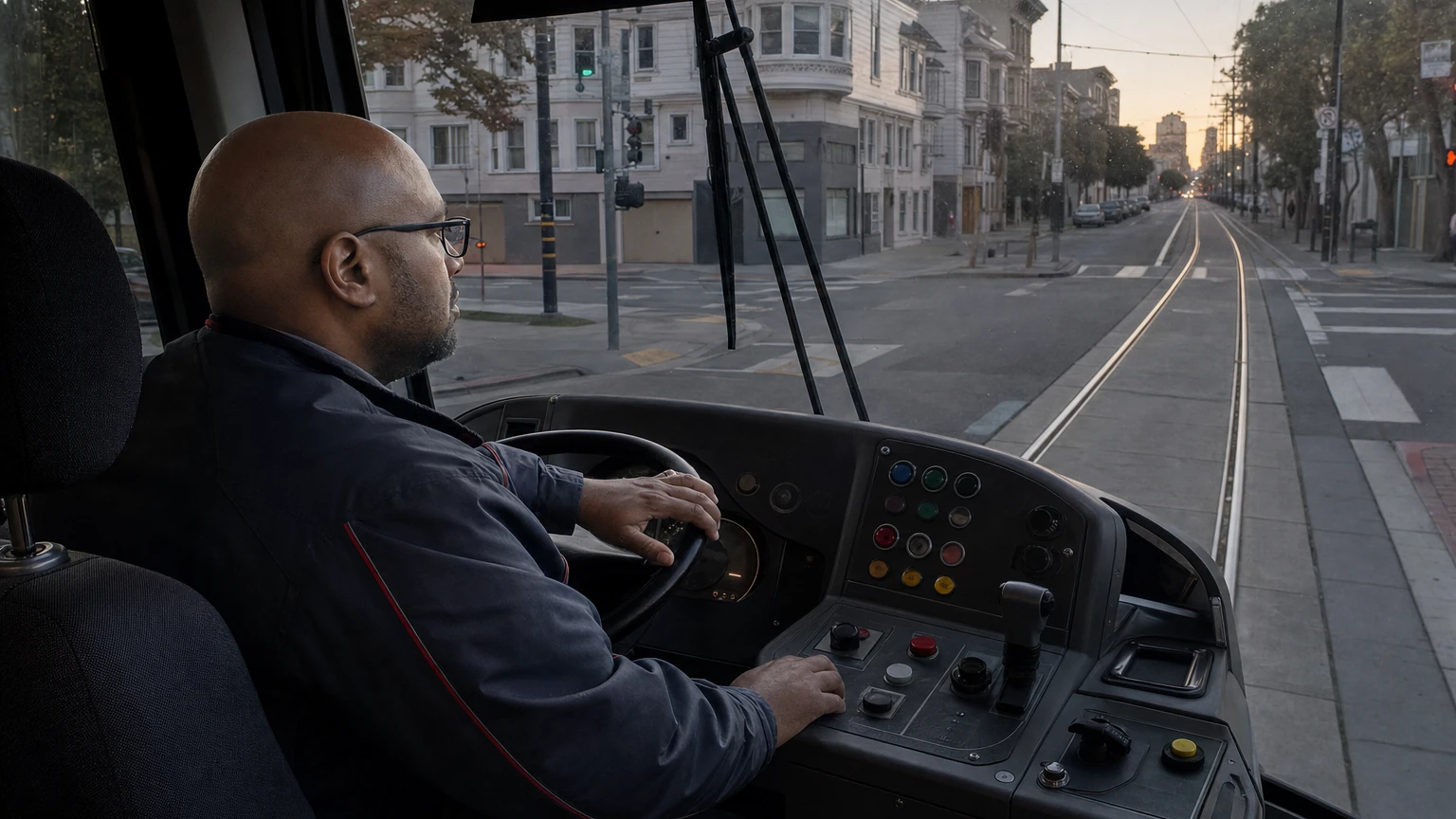
San Francisco's transit agency has now pointed to operator fatigue in two significant Muni rail incidents in less than a year. That does not establish that Muni operators are being systematically overworked. It does make a more basic question difficult to avoid: what kind of rest and workday does the job actually allow?
The latest case involves a July 31 L-Taraval collision. After onboard video surfaced in August showing the operator appearing to nod off shortly before the crash, SFMTA said in a statement reported by CBS Bay Area that vehicle and infrastructure issues had been ruled out and its initial determination was "operator error caused by fatigue." The formal investigation remains open with the California Public Utilities Commission.
SFMTA also said it had increased random video reviews and allocated additional rest time on all operator shifts. That is a systemwide response to a safety issue even though the agency has not publicly said that its prior scheduling rules caused the operator's fatigue.
A second fatigue-linked rail incident in less than a year
The July collision was not the first recent case. In November 2025, SFMTA said its completed investigation of a Sept. 24 N-Judah incident found "operator fatigue" was the cause. The train reached about 50 mph near the Sunset Tunnel exit before passengers were thrown around the car; SFMTA said the braking system and track infrastructure were operating as designed.
The two incidents are different and should not be collapsed into a single narrative. The N-Judah finding followed a completed SFMTA investigation. The July L-Taraval determination is still described by the agency as initial while CPUC review continues.
What a Muni operator shift can actually look like
The current 2024–2027 agreement between SFMTA and Transport Workers Union Local 250-A provides a normal full-time schedule of eight hours a day and 40 hours over five days. But the agreement also permits split runs — two pieces of work separated by a break — and says a full-time operator's total workday range can extend to 12 hours.
A 12-hour range is not the same thing as 12 hours of driving. Part of that span may be an unpaid gap between pieces. That distinction matters, but so does the practical reality that a split assignment can occupy much more of a worker's day than the paid driving time alone suggests.
The same agreement sets a minimum of eight hours off between scheduled work. Eight hours between shifts is not necessarily eight hours of sleep once travel home, meals, family obligations and the return commute are included.
Six continuous hours can come without a traditional lunch period
One provision is particularly easy to misunderstand. Operators assigned six or more continuous hours receive 20 minutes of straight-time pay in lieu of a lunch period.
That does not mean operators are prohibited from every brief personal-necessity or restroom stop. The contract separately addresses restroom facilities and other operating conditions. But it does mean the agreement expressly contemplates a six-plus-hour continuous assignment without a conventional unpaid lunch break.
If a relief operator does not report or an unexpected service disruption occurs, the agreement also allows dispatch to direct the operator already on the vehicle to continue beyond the scheduled relief time, subject to maximum driving-hour rules.
How much does a Muni driver make in 2026?
The city's current compensation schedule for Class 9163 Transit Operator, effective July 1, 2026, runs from $66,508 at Step 1 to $102,362 at Step 5.
| Pay step | Hourly base | Annual base |
|---|---|---|
| Step 1 | $31.9750 | $66,508 |
| Step 2 | $34.4375 | $71,630 |
| Step 3 | $36.9125 | $76,778 |
| Step 4 | $39.3625 | $81,874 |
| Step 5 | $49.2125 | $102,362 |
Those are base wages. Overtime, pension and health benefits can materially change total compensation, so base salary alone is not a complete measure of what an operator receives.
Can a starting Muni operator afford to live in San Francisco?
The comparison is nevertheless revealing. San Francisco's official 2026 income table puts 60% of Area Median Income for a one-person household at $68,050. A Step 1 operator's $66,508 base wage falls below that threshold.
For a three-person household, the city's 50% AMI threshold is $72,950. A new operator's base wage is below that level as well. A top-step operator's $102,362 base wage is approximately the city's 70% AMI figure for a three-person household.
Those comparisons do not prove the job is "underpaid" in a universal sense. They do establish that the people beginning a safety-critical transit job are paid a base salary that sits low in the income distribution of the city they serve.
Current staffing does not support a simple shortage story
There is evidence cutting against the simplest version of an overwork hypothesis. An SFMTA staffing presentation reported that efforts to redesign operator recruiting had resulted in 98% of budgeted transit-operator positions being filled.
That does not tell us how many operators are actually available in every division on every day after illness, leave, training and other absences. But it means we should not claim that a large current vacancy crisis is forcing the remaining workforce to cover service.
Sixth- and seventh-day overtime exists — but it is voluntary
The operator agreement includes a system for employees who request overtime on a regular day off, including work on a sixth or seventh day. The contractual process is voluntary, not evidence that SFMTA routinely orders seven-day weeks.
The unanswered question is how often operators use those opportunities and why. Some overtime may reflect agency coverage needs; some may reflect workers choosing additional income; both can be true at once.
What we still do not know about fatigue and workload
The public materials reviewed for this story do not show how many Class 9163 operators routinely work long ranges, how frequently the minimum eight-hour turnaround is used, or what share of the workforce works a sixth or seventh day in a typical month.
Those are the numbers needed before anyone can responsibly turn "fatigue" into a broader conclusion about systematic overwork.
SF News Today is seeking aggregate data on Class 9163 overtime hours and pay, sixth- and seventh-day work, unusually long duty ranges, near-minimum shift turnarounds, missed reliefs, unscheduled absences and fatigue reports. We are also seeking detail on the additional rest time SFMTA says it allocated after the July collision.
Until those records are available, the strongest conclusion is narrower: operator fatigue has become a documented Muni safety issue, the contract permits demanding schedules, and entry-level operator pay is modest by San Francisco income standards. Whether those facts are causally connected remains an open reporting question.