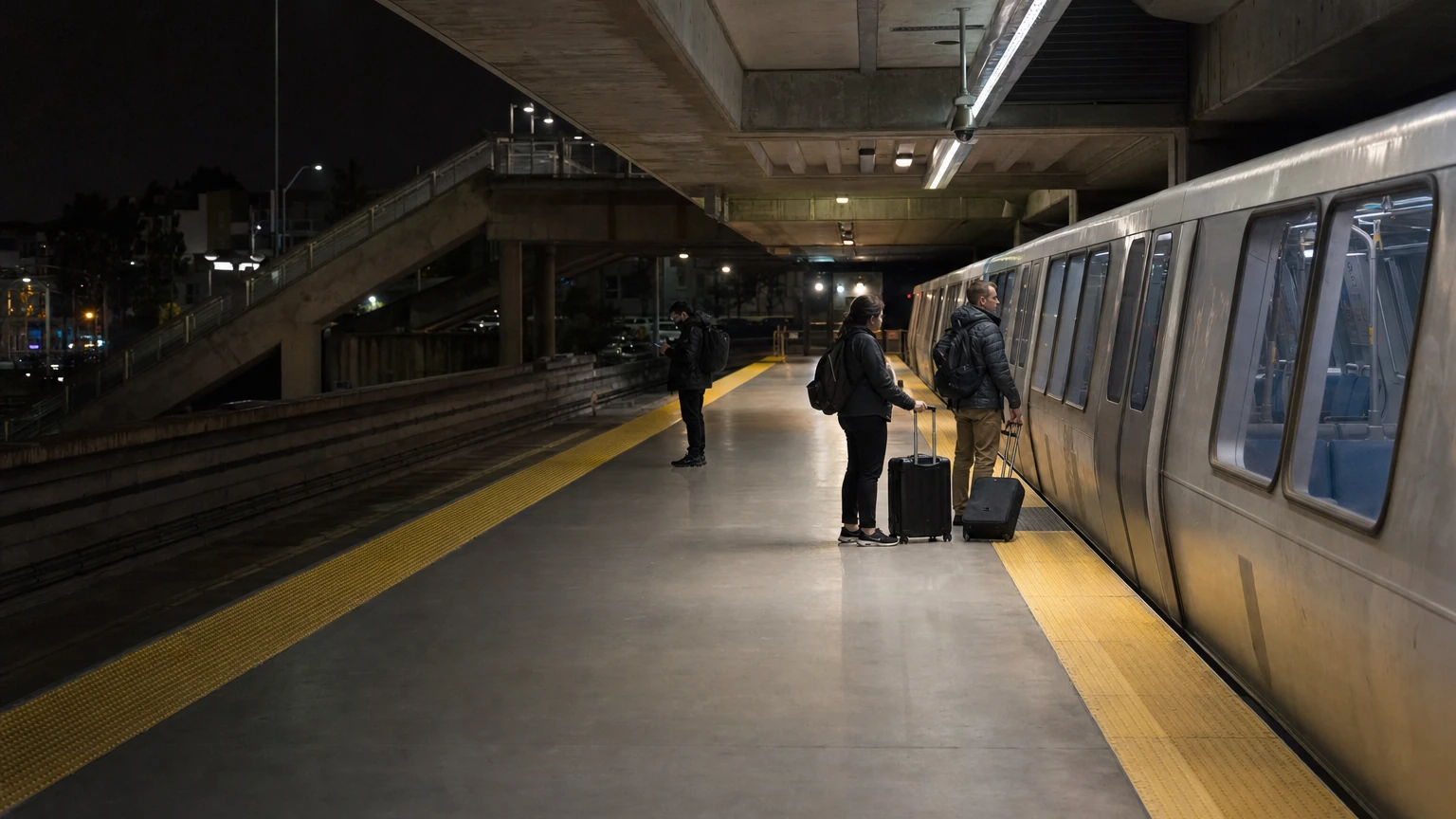
Getting from downtown San Francisco to SFO on BART is usually one of the simplest airport trips in the Bay Area.
At night, it currently requires a little more planning.
BART says passengers should expect delays of about 30 minutes beginning at 9 p.m. on some Sunday-through-Thursday nights while crews continue installing its Communications-Based Train Control system. The work affects the corridor around Daly City, Colma, South San Francisco, San Bruno, SFO and Millbrae.
For someone heading home, half an hour is inconvenient. For someone heading to an airport, it can be the difference between reaching the gate comfortably and watching the boarding time approach from a train.
Blue or Green Line? Transfer at Balboa Park, not Daly City
BART's schedule change that took effect August 10 altered several transfer patterns on the peninsula.
If you are riding a Blue or Green Line train and need to continue toward San Francisco International Airport, BART now advises transferring to a Red or Yellow Line train at Balboa Park. BART's August schedule notice says that gives riders an easier same-platform transfer.
Waiting until Daly City may require changing platforms, a bigger nuisance with luggage and a bigger risk when late-night service is already operating around construction.
Travelers starting at Powell Street, Montgomery Street, Civic Center or another downtown station may already be on an SFO-bound train and need no transfer. The important rule is to read the destination sign rather than assume every southbound train serves the airport.
Is BART still a good way to get to SFO at night?
Usually, yes — provided you build in the construction time.
BART says SFO is roughly a 30-minute ride from downtown San Francisco under normal conditions. The station is inside the International Terminal, and passengers for Terminals 1, 2 and 3 can use SFO's free AirTrain.
On an affected construction night, do not plan around the normal 30-minute figure. If BART is warning of roughly another 30 minutes, budget it.
The safest approach is to put your station and desired arrival time into BART's Trip Planner shortly before leaving, then check the current service advisories again.
What time does BART stop serving SFO?
BART describes airport service as operating until approximately midnight, with different morning start times on weekdays, Saturdays and Sundays. Sunday service begins later, which matters for early flights.
Do not interpret “until midnight” to mean you can arrive at any downtown station at 11:59 p.m. and still reach the airport. The relevant time is the last train from your station that actually connects to SFO.
Late-night construction can change trip patterns, which is another reason the live planner matters more than a memorized last-train time.
What about Millbrae and Caltrain?
The August schedule change also modified some BART-Caltrain connections at Millbrae. BART publishes a current transfer guide, and riders coming from the peninsula should check the connection rather than rely on an old routine.
For airport passengers, Millbrae is sometimes the right connection and sometimes an unnecessary detour. Use the actual itinerary generated for the time you plan to travel.
What does BART to SFO cost?
BART fares are distance-based, so there is no single “San Francisco to SFO” fare for every rider. The agency maintains a current fare calculator on its SFO airport guide.
Visitors can also use contactless bank cards, Apple Pay or Google Pay at BART gates; each passenger age 5 or older needs a separate payment card or device.
Use SF News Today's live transit page before leaving
SF News Today also maintains a live Muni and BART dashboard and transit page using official 511 Bay Area data. Those pages are useful for active alerts and arrivals, while BART's own Trip Planner remains the authority for the exact airport itinerary.
If you are traveling the weekend of August 29–30, also check our guide to the Green Line service disruption and the separate Muni service changes beginning Aug. 29.
How much extra airport time should you build in?
There is no single buffer that works for every flight because the construction schedule, your origin station and airport security time all vary. But the agency's own warning gives travelers a sensible planning floor: if a construction night can add roughly 30 minutes, do not build an itinerary that succeeds only if the train runs on its normal daytime schedule.
A downtown rider who normally treats the airport ride as about half an hour should think in terms of the whole door-to-terminal trip: walking to the station, waiting for the train, any transfer, the possible construction delay and the AirTrain or terminal walk after reaching SFO. That is especially important for the last useful trains of the night, when missing one connection may not simply mean waiting a few more minutes.
Rideshare or taxi service can be a useful fallback when the live planner shows a poor connection or when a late flight leaves little margin, but road travel has its own traffic and price uncertainty. The useful comparison is not “BART versus car” in the abstract; it is the live BART itinerary versus the road option at the time you actually need to leave.
The practical rule
After 9 p.m. Sunday through Thursday, check for construction. If you are on Blue or Green and need an SFO train, use BART's new Balboa Park transfer advice. Check the last useful train from your station, and give yourself more margin than you would for a normal daytime ride.
BART's modernization work is temporary. Missing a flight is not.