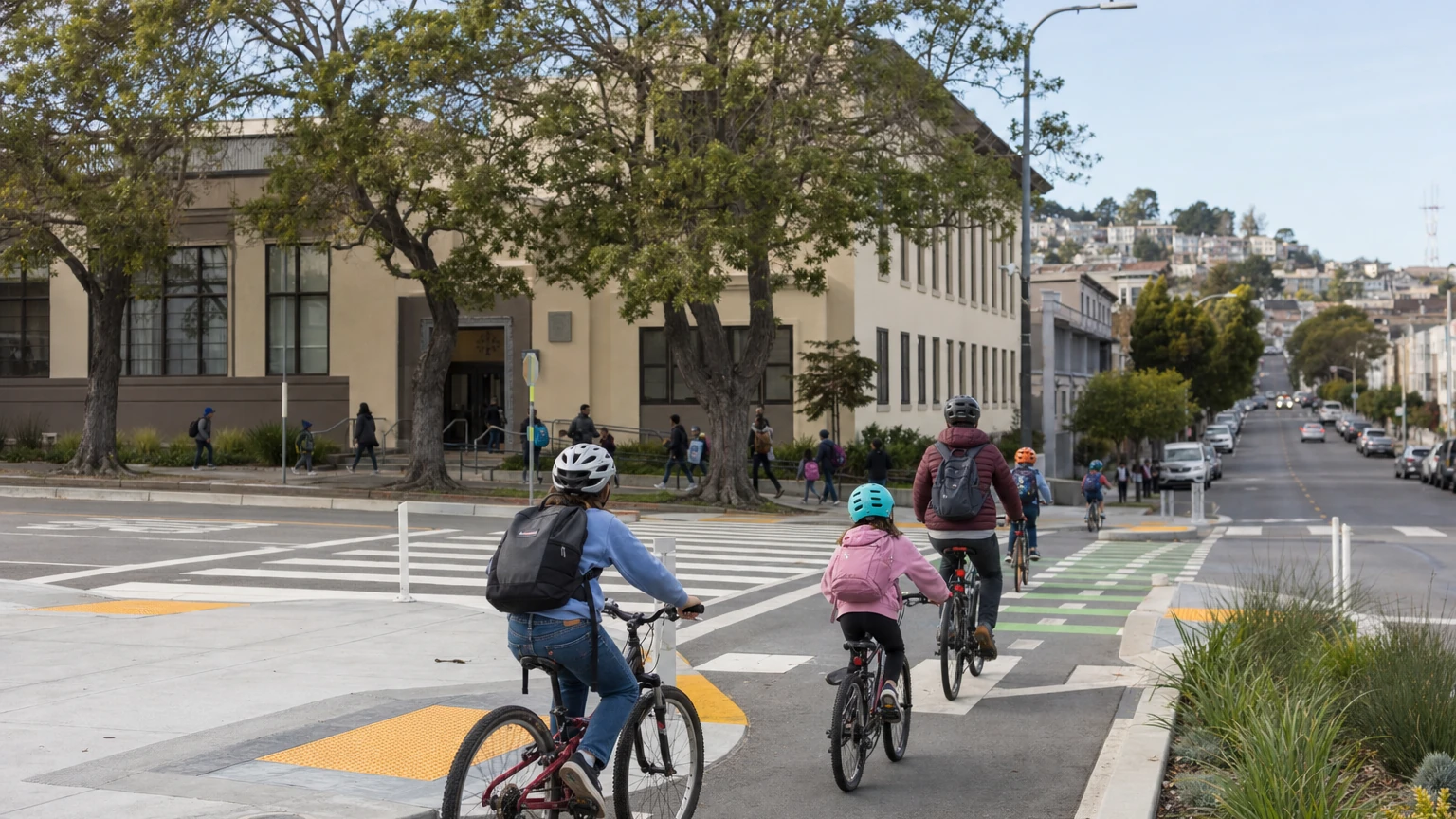
SAN FRANCISCO — San Francisco’s long-term bike network reaches only a fraction of the city’s K–12 schools directly today, according to a new SFMTA plan that aims to close the gaps one school at a time.
The draft Safe School Connections approach, scheduled for discussion at the SFMTA Board on Sept. 1, sets a goal of creating a safe, accessible connection from all 249 public and private K–12 schools in San Francisco to the city’s All Ages and Abilities biking and rolling network. The Board presentation says only 37 schools currently sit directly on that network.
This is a planning framework, not a promise that 249 construction projects are already funded. SFMTA says the full effort could take up to a decade and will require additional staff and money.
How far are San Francisco schools from the safer bike network?
| School relationship to network | Schools | Share of 249 |
|---|---|---|
| Directly connected to existing network | 37 | 15% |
| About one block from existing network | 36 | 15% |
| Would connect directly to potential network | 57 | 23% |
| About one block from potential network | 46 | 18% |
| More than one block away | 73 | 29% |
SFMTA says most of the final 73 schools are still within about a quarter-mile of the potential network. When the broader potential biking-and-rolling network is completed, the agency says 94 of 249 schools would have a direct existing or planned connection.
That still leaves a large group requiring additional neighborhood links, which is the reason SFMTA is proposing a separate school-connector program rather than assuming the citywide bike plan solves school access on its own.
What is a “School Connector” street?
SFMTA is not proposing the same protected bike lane outside every school. The draft describes School Connector streets as combinations of physical street treatments and community programs chosen with each school community.
The toolkit shown to the Board includes separated bike lanes, traffic circles, traffic diverters, speed humps or tables, paint and signs, School Street activations, decorative streetscape treatments and placemaking or gathering spaces.
In practical terms, one school might need a short protected connection to an existing bikeway; another might need slower vehicle speeds or a traffic diverter on a residential street. The program is deliberately framed as a menu rather than a single citywide design.
Which schools could go first?
SFMTA has not published a final list of first-round schools.
In 2027, staff plans to begin identifying potential projects among schools that are about one block from the existing All Ages and Abilities network and schools about one block from a potential network segment expected within the next five years.
From there, SFMTA says it will consider several factors, including whether a school:
- is on the High Injury Network;
- is a Safe Routes to School “Focus School”;
- fits Community Action Plan priorities;
- has a community ready to participate; or
- can be connected efficiently as part of another street project.
The presentation explicitly says those criteria are not listed in order of priority.
The plan covers SFUSD and private schools
The 249-school total is broader than SFUSD alone. SFMTA says the goal includes all SFUSD schools plus private schools serving kindergarten through high school.
That makes the affected population much wider than students who currently bike. The surrounding street changes could matter to families who walk, take Muni or drive, as well as neighbors living near the eventual connector streets.
How SFMTA says it will measure success
The agency proposes measuring more than miles of bikeway. Its draft outcomes include the number of schools connected, connections for schools on the High Injury Network and in Equity Priority Communities, increases in walking/biking/rolling/transit trips, gaps closed in the broader bike network and progress on equity goals.
The presentation also acknowledges that a safe connection is only one part of whether a student travels actively. Access to a bike, secure bike parking, distance from school and where a child goes before or after class can all affect the choice.
How much will Safe School Connections cost?
SFMTA has not published one citywide price tag for connecting all 249 schools.
The agency says the work would have to draw on existing capital programs, Safe Routes to School funding and local, state or federal grants. It also says the ten-year goal will require finding additional staff and financial resources.
That is an important limitation: the Board is being asked to discuss a program approach and launch outreach, not approve a fully funded decade-long construction package.
Public feedback runs through Sept. 30
SFMTA plans a public-outreach period throughout September. The presentation directs residents to SFMTA.com/SafeSchoolConnections to review the draft and submit feedback through Sept. 30.
Staff then plans to refine the approach in October and November, return with a final proposal in late 2026 or early 2027, and identify the first potential school connections during 2027.
For families following both school assignment and transportation questions this week, SF News Today is also tracking the Sept. 4 SFUSD waitlist deadline and Sept. 8 Spring Transfer opening.