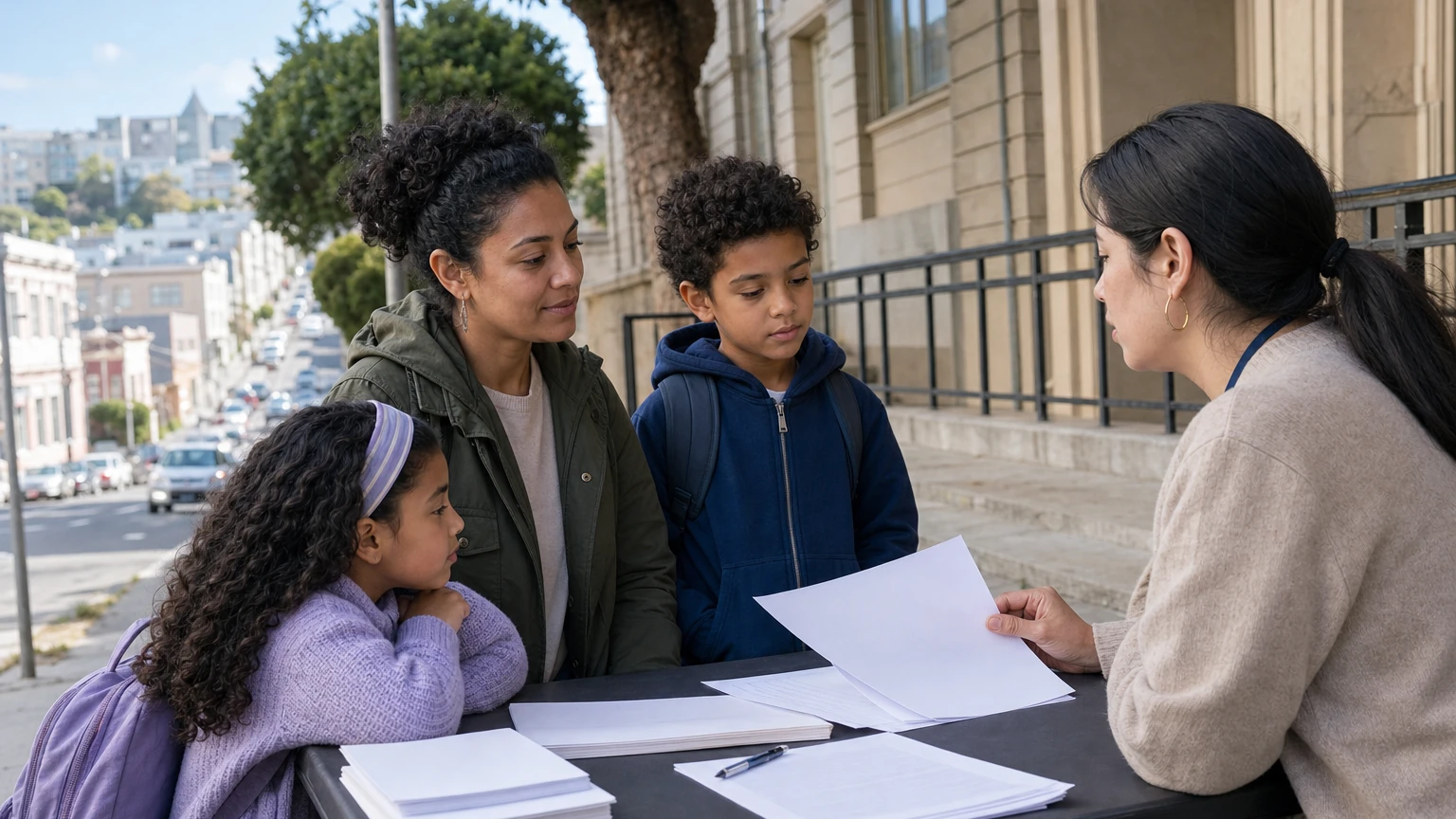
SAN FRANCISCO — SFUSD’s 2026–27 waitlists are finished, and the district’s Spring Transfer application is now available for current SFUSD students who want to move schools for the spring semester.
The request window runs from Sept. 8 through Nov. 13. But there is a consequence families should understand before applying: if SFUSD grants the transfer, the new school automatically replaces the student’s existing assignment.
This is not a fourth waitlist choice and it is not a no-risk way to see what another school might offer.
How do you apply for SFUSD Spring Transfer now?
SFUSD says the Spring Transfer application is available beginning Sept. 8. The district’s current Spring Transfer page is the safest starting point because it is where SFUSD posts the live application and process instructions.
SFUSD’s current Spring Transfer page confirms that the application is available beginning Sept. 8, but the page does not clearly describe a separate ParentVUE-only submission path. Families should use the district’s live Spring Transfer page or contact the Enrollment Center rather than relying on an older enrollment workflow.
Who can apply for SFUSD Spring Transfer?
SFUSD says Spring Transfer is available to currently enrolled SFUSD students, excluding charter-school students. A family may request one school and pathway only.
Lowell High School and Ruth Asawa School of the Arts do not accept new students through this Spring Transfer process.
The 2026 Spring Transfer dates
| Date | What happens |
|---|---|
| Sept. 8 | Spring Transfer application opens. |
| Oct. 9 | SFUSD plans to publish the first active-request list. |
| Oct. 23 | Updated active-request list. |
| Nov. 12 | Final pre-deadline active-request list. |
| Nov. 13 | Last day to submit, revise or cancel a request. |
| Week of Dec. 14 | Assignment results are mailed. |
| Jan. 4, 2027 | Students with successful transfers begin at the new school. |
The rule families should understand before applying
SFUSD says a successful Spring Transfer assignment automatically replaces the student’s current school assignment. The student is automatically unenrolled from the previous school.
There is no accept-or-decline option after a successful result. If a family no longer wants the request, SFUSD says it should be cancelled before the Nov. 13 deadline.
If the request is unsuccessful, the student remains enrolled at the current school.
Is Spring Transfer first-come, first-served?
No. SFUSD describes Spring Transfer as an assignment process, not a first-come line. When requests exceed available seats, the district applies its student-assignment system, relevant tiebreakers and random-number ordering where necessary.
That means filing at the first minute on Sept. 8 is not described by the district as giving a family priority simply for being earlier.
What will the active-request lists tell families?
SFUSD plans to publish snapshots on Oct. 9, Oct. 23 and Nov. 12 showing active requests by school, grade and program. Those lists can help families see demand before the Nov. 13 deadline.
They are not admission probabilities. Available seats can change and assignment preferences still matter.
When do SFUSD waitlists end in 2026?
For the 2026–27 cycle, SFUSD waitlists ended on Sept. 4, 2026. The earlier Aug. 28 waitlist application deadline has passed; the figures below preserve the final waitlist context before Spring Transfer opened.
What happened during the 2026 waitlist cycle?
The Spring Transfer window follows a waitlist cycle that ended Sept. 4. The most recent public weekly workbook used in SF News Today’s original Aug. 26 reporting was dated Aug. 17 and contained 9,229 current school-grade-program waitlist placements. That figure was not 9,229 unique students because one student could appear on more than one waitlist.
| School / grade / General Education | Current waitlist | Offers made so far |
|---|---|---|
| Abraham Lincoln HS — Grade 9 | 631 | 36 |
| George Washington HS — Grade 9 | 518 | 91 |
| A.P. Giannini MS — Grade 6 | 325 | 2 |
| Roosevelt MS — Grade 6 | 229 | 0 |
| Aptos MS — Grade 6 | 192 | 3 |
| Presidio MS — Grade 6 | 180 | 68 |
| Balboa HS — Grade 9 | 173 | 96 |
| West Portal ES — TK | 159 | 1 |
| Sunset ES — Kindergarten | 145 | 4 |
| Lawton K–8 — TK | 140 | 3 |
The table is historical context from the ended waitlist process. It should not be used as a prediction of Spring Transfer availability.
What families should do now
Before applying, decide whether the requested school is genuinely preferable to the student’s current assignment. A successful result is a real transfer, not an offer a family can casually hold while deciding whether to stay.
Families can start with the district’s Spring Transfer page and cross-check the Enrollment Key Dates. Questions about an individual student or the current submission route should go to the SFUSD Enrollment Center at 415-241-6085.