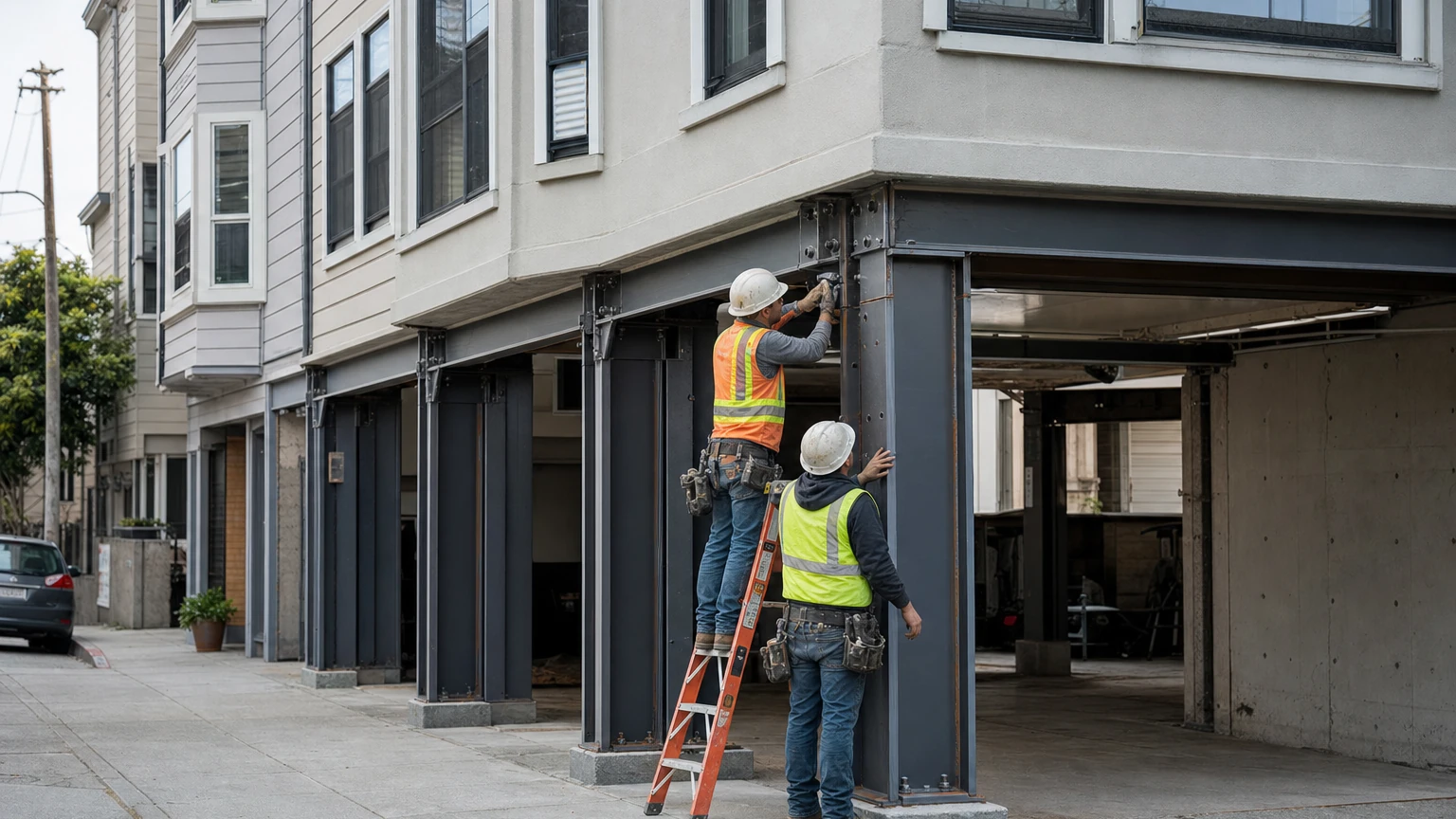
California has opened a new round of earthquake-retrofit grants that can pay qualifying apartment owners as much as $49,600 to strengthen vulnerable soft-story buildings.
San Francisco is one of the participating cities. But a comparison of the state grant rules with San Francisco's mandatory soft-story program reveals an important limit: some San Francisco buildings that are required to retrofit are too large to qualify for the new grant.
The California Residential Mitigation Program's Earthquake Multi-Unit Retrofit program, or EMR, opened registration Aug. 19 and runs through Sept. 30. The program is aimed at wood-frame apartment buildings with five to 10 residential units, built before Jan. 1, 1991, with a qualifying soft, weak or open-front first story and an existing mandatory retrofit order from the local jurisdiction.
What the grant actually pays
Under the published rules, the program can reimburse 70% of eligible engineering and permit costs, up to $7,000, plus 70% of eligible construction costs, up to $4,260 per residential unit.
The advertised maximum of $49,600 is therefore the ceiling for a 10-unit eligible building: $42,600 in per-unit construction support plus as much as $7,000 for engineering and permits.
A five-unit building has a lower mathematical ceiling: five times $4,260, or $21,300, plus up to $7,000 for engineering and permits — $28,300 before the 70% reimbursement limits are applied to actual eligible costs.
That distinction is useful for owners reading the headline number. The maximum grant is not a flat payment, and smaller eligible buildings cannot reach the same construction cap as a 10-unit property.
San Francisco still had 284 non-compliant buildings in its February 2025 count
San Francisco's mandatory soft-story retrofit program dates to 2013 and targets older wood-frame multifamily buildings whose first stories can be weakened by large garages, storefronts or other openings.
A December 2024 Department of Building Inspection report said 4,648 of 4,941 buildings in the program had completed the compliance process, leaving 293 out of compliance. The city's February 2025 consolidated-plan materials later listed 4,655 completed and 284 non-compliant.
Those figures are historical snapshots, not a claim that 284 buildings remain today. DBI's public program data is updated on an ongoing basis, so the current total may be lower. The February 2025 figure is the latest official citywide count SF News Today is relying on for this story.
The December 2024 breakdown also showed that the remaining cases were at different stages: some owners had not filed a permit application, some had applied but not obtained a permit, some had an issued permit but incomplete work, and some had not yet obtained a certificate of final completion.
The state grant is narrower than the city's mandate
San Francisco's program organizes covered buildings into tiers based on characteristics such as unit count, occupancy and location. The city's public dataset documentation describes Tier II as buildings containing 15 or more dwelling units, excluding properties that fall into certain other tiers.
That creates a straightforward mismatch with the new state program. A 15-unit San Francisco soft-story building can be under a mandatory city retrofit obligation but cannot satisfy a state grant rule that requires five to 10 units.
The grant therefore cannot be understood as a universal funding solution for San Francisco's remaining holdouts. It may be valuable for a subset — especially smaller apartment buildings that have not begun physical construction — while leaving larger mandatory properties outside the program by definition.
The next useful number is how many holdouts are actually eligible
The city publishes property-level soft-story status data, and the state publishes its eligibility rules. Joining those two sets of information is the next logical step: how many currently non-compliant San Francisco buildings have five to 10 units, meet the other state criteria and have not progressed too far into construction to participate?
That would tell tenants and owners whether the grant reaches a large share of the remaining problem or only a narrow slice.
For now, the public records already establish one clear boundary. California is offering meaningful money for earthquake safety, but being required by San Francisco to retrofit does not automatically make a building eligible for the state money.