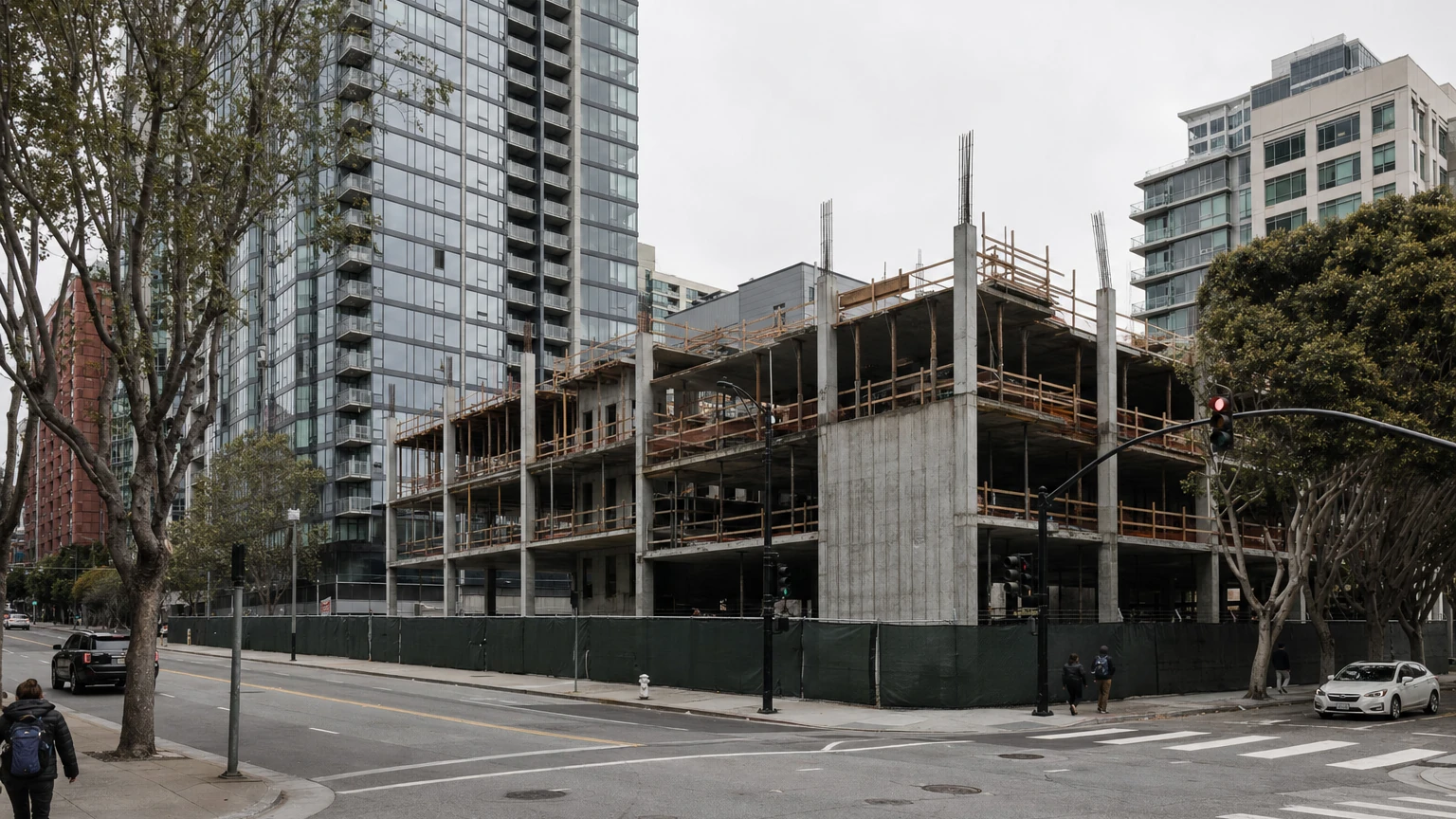
For years, 960 Howard Street has been one of those San Francisco developments that seems to become a different project every time someone looks at it.
It began as a largely commercial project, evolved through several residential proposals and is now planned as one of downtown San Francisco's more unusual affordable-housing developments: 202 apartments built through adaptive reuse and a mass-timber addition above an existing three-story base.
Two hundred of those homes are intended to be income-restricted.
After a financing delay this summer, two fresh public records show activity at the SoMa property: a July 30 building-permit filing and an August 10 federal OSHA inspection.
What is actually planned at 960 Howard
San Francisco Planning's latest Housing Inventory describes the current proposal as a revision to an earlier approved project. It retains mass-timber construction above the existing three-story mixed-use base while expanding the residential program to 202 units.
The existing upper floors would be converted to residential use while the ground level retains a mixture of production, distribution and repair uses, retail and residential infrastructure. Planning says 200 apartments would be affordable at an average area median income of 60% or below, excluding manager units.
State financing documents put the affordability mix at 21 homes at 30% of area median income, 41 at 50%, 73 at 60% and 65 at 70%, plus two unrestricted manager units.
The project had a financing plan — then a transaction did not close
In April, CalHFA approved the project for its Mixed-Income Program. State board materials describe a financing stack involving tax-exempt bonds, low-income housing tax credits, a CalHFA permanent loan and other sources.
Then, in June, the San Francisco Chronicle reported that uncertainty surrounding proposed California legislation had disrupted a roughly $25 million tax-credit equity transaction involving U.S. Bank. The project had been expected to break ground, but that closing did not happen on schedule.
That is what makes the newer records worth watching.
The July 30 permit is narrower than “build 202 apartments”
The city's Building Permits dataset shows a July 30 filing associated with 952/960 Howard and Planning case 2025-007856PRJ. The record describes about $1.5 million of work in the existing building and identifies 15 proposed dwelling units.
DBI's dataset distinguishes between an application being filed and later milestones such as approval and issuance. So the presence of a permit application means the project team is still moving work through the system; it does not mean that the work has already been authorized to begin.
The narrower scope also creates a useful question: Are those 15 homes an early phase within the eventual 202-unit project, and can that base-building work move while the larger financing package is being resolved?
The OSHA inspection is not evidence of a safety violation
Federal OSHA's public database shows a planned, partial safety inspection of oWow Construction LLC at 960 Howard opened on August 10. The case remains open in the public record reviewed by SF News Today.
The database does not currently show a posted citation from that inspection.
That means the OSHA record establishes that an inspection occurred at an oWow construction workplace at 960 Howard. It does not establish that OSHA found unsafe conditions, and it does not establish that the full housing tower has restarted.
Why 960 Howard matters beyond one address
The property is a useful case study in what San Francisco is trying to do with stalled development. The existing concrete base was built during the pandemic for commercial use before market conditions changed. The proposal was then restructured into affordable housing.
It is also an unusually ambitious use of mass timber for multifamily housing in central SoMa, with no on-site automobile parking and substantial bicycle parking.
That combination gives 960 Howard a long search tail — but the central question remains simple: when will 202 planned homes actually move from financing and permit records into construction?
A project that has already changed several times
The current plan is not the first residential version of 960 Howard. Earlier public planning documents described a smaller mass-timber addition and a much lower unit count. The later affordable-housing restructuring increased the project to 202 homes and changed the economics of the site.
That history is useful when reading any single permit record. Large San Francisco developments often move through overlapping planning approvals, building-permit applications, financing commitments and construction phases. A new filing can be meaningful without representing the entire project.
For nearby residents and people watching the SoMa housing pipeline, the practical questions are therefore about sequence: which work can proceed in the existing base, which permits depend on the larger financing close, and when the mass-timber addition itself is authorized to move.
The next record that matters
For now, the most accurate description is neither “dead” nor “back under construction.” It is a major affordable-housing project whose original 2026 schedule slipped after a financing problem while permitting and site activity continued.
The next consequential evidence will be a financing close, an issued permit covering the full project or a confirmed construction start.