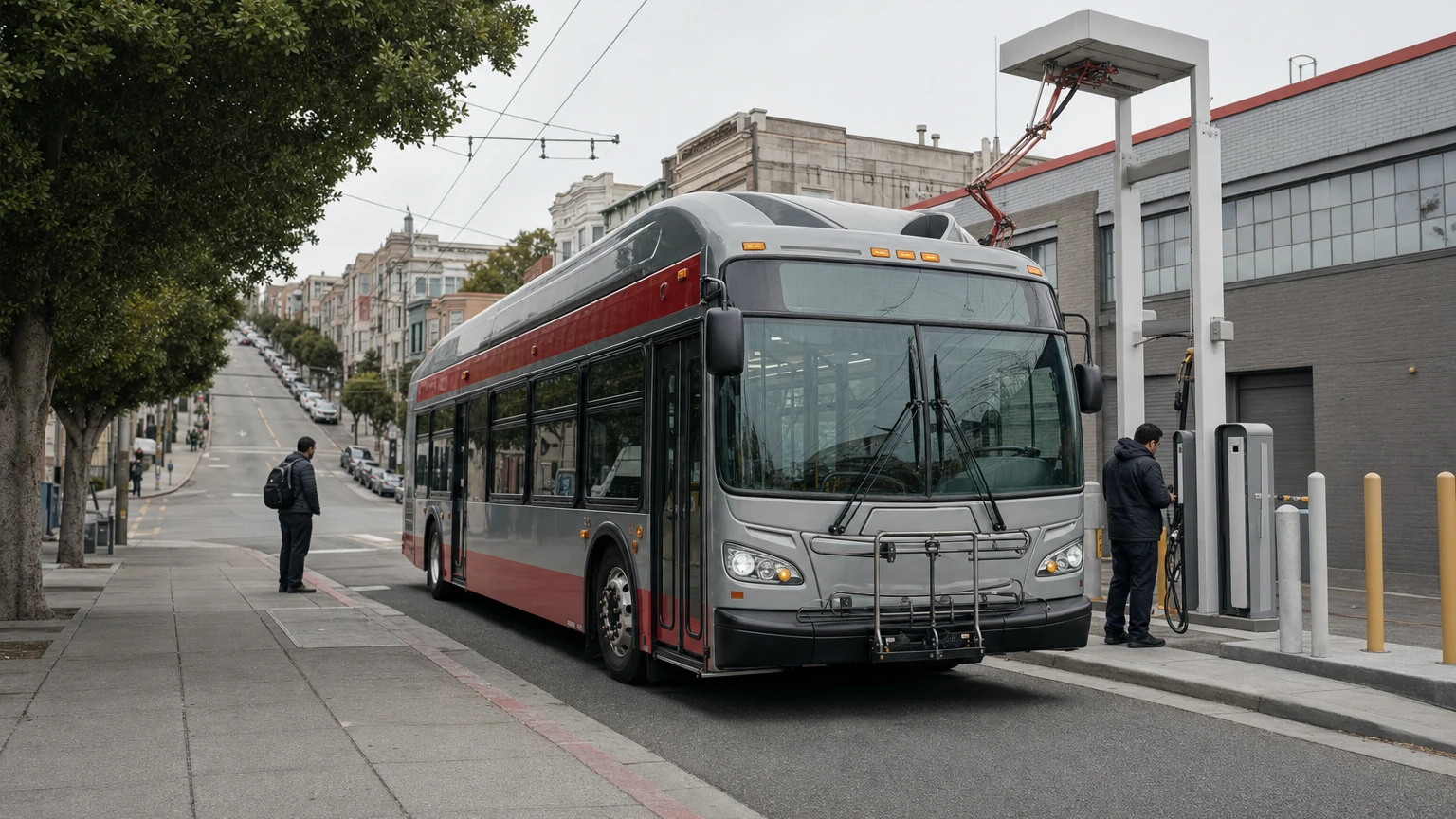
SAN FRANCISCO — Muni is asking for more time to meet California’s zero-emission bus purchasing requirements, arguing that the required pace of battery-bus purchases and bus-yard electrification would cost hundreds of millions of dollars the agency does not currently have.
At its Sept. 1 meeting, the SFMTA Board is scheduled to consider authorizing staff to pursue five consecutive one-year exemptions from the California Air Resources Board’s Innovative Clean Transit rules, covering bus procurements from 2027 through 2031. The request is based on financial hardship. The full Sept. 1 board packet includes the staff report and proposed CARB letter.
This is not one automatic five-year waiver. CARB considers the exemption annually. The Board action would give SFMTA authority to keep applying each year if the agency still meets the hardship criteria.
Why SFMTA says the next five years would cost $452 million more
SFMTA estimates that complying with the zero-emission purchase requirement between 2027 and 2031 would add $223 million in vehicle costs and another $229 million in facility-electrification costs.
| Five-year cost component | Planned hybrid/conventional path | Zero-emission path | Difference |
|---|---|---|---|
| 40-ft and 60-ft buses + large cutaways | $617 million | $840 million | $223 million |
| Kirkland + Islais Creek electrification needed in 2027–31 | Not included in hybrid path | $229 million | $229 million |
| Total incremental cost | — | — | $452 million |
The staff report calls that a lower-end estimate because it does not include paratransit electrification costs or financing costs.
Muni plans hundreds of hybrid buses through 2031
The five-year fleet plan calls for 132 40-foot diesel-electric hybrids and 224 60-foot diesel-electric hybrids. It also includes 22 large gasoline paratransit cutaways that fall under the state rule and 78 smaller gasoline cutaways that do not.
Those purchases are about replacement timing as much as propulsion. SFMTA says it typically plans bus procurements years in advance, and warns that without an exemption path it could be forced to keep aging vehicles in service beyond their useful lives while waiting for facilities capable of supporting battery buses.
A $30 million electric-bus grant is now paying for hybrids
The federal-funding history in the staff report is one of the more striking parts of the request.
Since 2019, SFMTA says it submitted about $473.3 million in applications to federal bus/facility and RAISE programs and received about $79.1 million in awards shown in its table.
A $30.1 million 2023 award for Woods and Islais Creek battery-electric bus facility upgrades was later reprogrammed to purchase diesel-electric hybrid buses. SFMTA says that change was made to retain the federal money while aligning with the current federal administration’s funding priorities.
The agency also points to large unsuccessful requests, including $99.1 million for Kirkland in 2022, $115 million for Potrero Yard modernization in 2024 and $70.5 million for Kirkland in 2024.
The bus yards are as important as the buses
SFMTA’s case is not simply that a battery bus costs more than a hybrid. Hundreds of buses require charging, electrical service, maintenance space and yards that can continue operating while construction proceeds.
Potrero Yard closed earlier this year for a rebuild expected to run through 2030. SFMTA says expanding Potrero’s trolley-bus capacity is necessary before it can shuffle vehicles around and electrify other facilities. The staff report says there is currently “no conceivable path” to fully electrifying another SFMTA facility before the Potrero rebuild is complete.
The agency also cites its recent experience with years-long waits for PG&E electrical service and grid improvements needed to support battery-electric buses.
The longer-term electrification premium is estimated at $1.663 billion
The $452 million figure is the near-term 2027–2031 gap. SFMTA separately compares two longer-range scenarios for its fleet and facilities.
| Long-term scenario | Vehicles | Facilities | Total |
|---|---|---|---|
| With electrification | $2.717 billion | $5.129 billion | $7.846 billion |
| Without added battery-bus electrification | $2.148 billion | $4.035 billion | $6.183 billion |
| Incremental electrification cost | $569 million | $1.094 billion | $1.663 billion |
Those are capital-planning estimates, not a bill due in one year. The distinction matters: $452 million is the five-year cost gap supporting the immediate exemption request; $1.663 billion is SFMTA’s broader estimated incremental cost of the electrification scenario over the longer transition.
Muni is still buying battery-electric buses
The exemption request does not mean SFMTA is abandoning zero-emission transit. The agency has operated electric trolley buses for decades and says it remains committed to a fully zero-emission fleet.
A separate Transit Division update for the same Sept. 1 Board meeting shows 18 battery-electric buses already on order from New Flyer, Gillig and Solaris. Deliveries are scheduled to begin in September 2026 and continue into 2028.
SFMTA says it has tested 12 battery-electric buses from four manufacturers since 2022, including how the technology handles San Francisco hills and service days that can exceed 20 hours.
What California’s rule requires
CARB’s Innovative Clean Transit regulation is designed to move public transit agencies toward zero-emission bus fleets by 2040. For large agencies, qualifying new motor-bus purchases were required to be at least 25% zero-emission beginning in 2023, rising to 50% in 2026 and 100% in 2029.
Electric trolley buses are themselves zero-emission vehicles, but the rule does not let SFMTA simply count its existing trolley fleet as credit toward the new motor-bus purchase percentages.
Why ordinary Muni riders should care
SFMTA’s argument is ultimately about service reliability. Its approved operating budget already faces major projected deficits, and the agency says the operating budget cannot absorb the capital required for the zero-emission transition.
Without more outside capital funding, SFMTA says spending on electrification could divert limited resources from transit operations. It also argues that delaying replacement purchases while waiting for compliant infrastructure could force older buses to remain in service longer, increasing maintenance costs and reliability risk.
That creates a real tradeoff rather than a simple choice between “green” and “not green”: move faster on battery-bus infrastructure with money the agency says it does not have, or keep buying hybrids while seeking more time and funding for the full transition.
What happens at Tuesday’s Board meeting
The SFMTA Board meets at 1 p.m. Tuesday, Sept. 1 at City Hall. If the Board approves Item 11, SFMTA would be authorized to submit the current financial-hardship request and subsequent annual requests through 2031 if needed.
CARB, not the SFMTA Board, makes the exemption decision. The state process remains annual, so approval Tuesday would not itself guarantee five years of waivers.