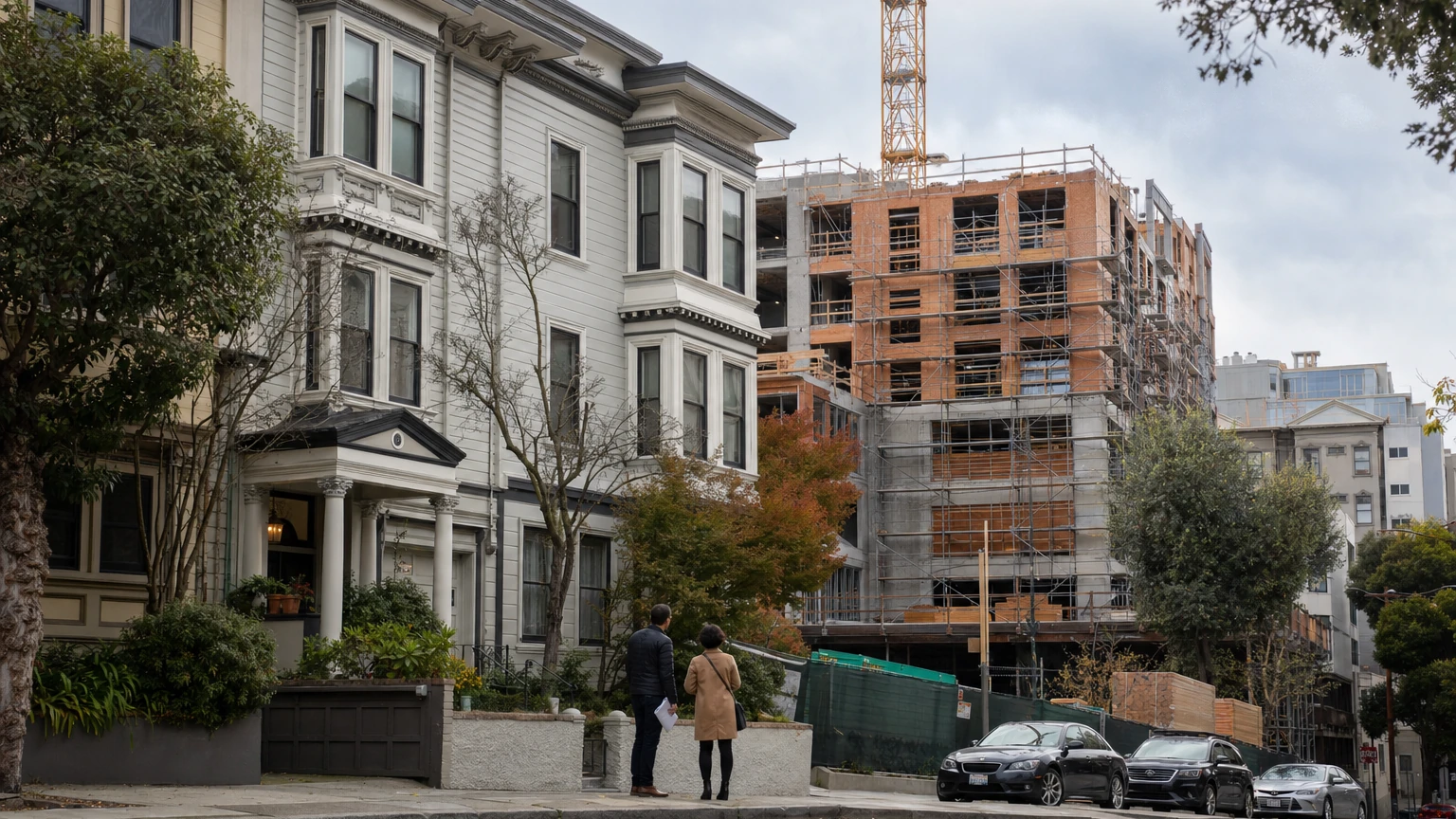
San Francisco is trying to do two things at once: make housing easier to build and dramatically expand the number of places it formally protects as historic.
Mayor Daniel Lurie and Board President Rafael Mandelman have announced a preservation push that adds seven planners, about $700,000 for preservation consultants and a citywide survey intended to identify thousands of additional historic resources. The stated goal is to roughly double the number of protected landmark and historic-district resources by 2030.
At the same time, San Francisco Planning’s latest pipeline report counts 74,888 housing units in active projects as of April 2026.
Put those two numbers next to each other and it is tempting to conclude that a landmarking drive is about to collide with tens of thousands of homes.
The public record does not support that conclusion.
Board File 260622 changes the process, not the landmark map by itself
Pending Board File 260622, sponsored by Mandelman, amends the Planning Code to streamline and clarify the landmark and historic-district designation process. Planning’s legislation tracker lists the measure as a Historic Preservation Commission item in August.
That distinction matters. The ordinance does not, by itself, designate 2,500 buildings. Individual landmarks and districts still have to be identified and moved through the designation process.
The city is deliberately trying to move much faster
The broader Lurie-Mandelman initiative is designed to accelerate that pipeline of designations. The additional staff and consultant money are intended to finish a citywide survey and move more properties into formal protection, with officials describing a goal of roughly doubling protected resources by 2030.
Mandelman’s argument is that earlier identification can create certainty: developers would know before filing whether a property is likely to be preserved, rather than discovering historic-resource issues late in an expensive project.
Housing advocates make the opposite institutional argument: once a property is designated, demolition and major alteration face additional review, and thousands of new designations could reduce the practical capacity created by recent state and local housing reforms.
The housing pipeline is huge — but half is in 13 mega-projects
San Francisco Planning’s 2026 Q1 Housing Development Pipeline contains 74,888 net new units.
| Pipeline stage | Units |
|---|---|
| Under construction | 3,301 |
| Site permits issued | 1,219 |
| Building permits approved | 2,422 |
| Building permits filed | 7,856 |
| Building permits not yet filed | 9,477 |
| Applications filed / under review | 13,036 |
| Major multi-phase projects | 37,577 |
The last row is the critical one. Half of the entire pipeline sits in major master-planned developments such as Hunters Point/Candlestick, Treasure Island, Parkmerced, Potrero Power Plant, Pier 70, Mission Rock and the Flower Mart.
Those projects are not a random collection of small Victorian parcels waiting to be individually landmarked. That alone shows why “2,500 more historic resources” cannot simply be translated into “thousands of housing units lost.”
Where the real collision could occur
The more plausible conflict is at smaller infill sites in rezoned neighborhoods, where a developer may need to demolish or substantially alter an existing building to use new housing capacity. A landmark designation can change that project’s design, review path, economics or feasibility.
But “potentially affected” can mean several different things: a site can be individually landmarked; it can be a contributor to a historic district; it can be identified as an eligible historic resource without local landmark status; or a neighboring resource can shape design review. Those categories should not be collapsed into one number.
San Francisco’s own Housing Element creates a future constraint test
The city’s adopted Housing Element contains an underappreciated safeguard. If San Francisco has issued building permits for fewer than 29,049 new units by January 31, 2027, Program 8.1.5 requires additional rezoning and constraints reductions.
It also says the city should not impose new governmental constraints on housing after that date unless the new constraint is offset by removing or mitigating another one. State housing officials have said they will monitor implementation.
That does not automatically invalidate future landmark designations. Historic-preservation law and housing law are more complicated than a one-line conflict rule. But it means the city’s preservation expansion is happening against a formal housing commitment that increasingly requires officials to quantify constraints rather than discuss them abstractly.
What a real parcel-level answer would require
The city already publishes the ingredients for a better analysis: the Development Pipeline dataset, Planning and DBI permit records, the citywide cultural-resources survey and individual landmark/district records.
A defensible cross-reference would match parcels, not neighborhood names, and separate projects by status. It should ask: How many active housing sites are already historic resources? How many are proposed for designation? How many units depend on demolition or significant alteration? How many projects can adaptively reuse the resource instead?
Until that overlay is completed, neither side should claim a giant number of homes saved or destroyed by the landmark program.
The tension is real even if the scary number is not
Historic designation is not automatically anti-housing. San Francisco also has policies encouraging adaptive reuse of historic buildings, and many pipeline units are nowhere near the individual-property preservation fight.
But designation is a land-use regulation, and the city is proposing to use it much more often at the same time it is under extraordinary pressure to reduce housing constraints.
The important question is therefore not whether San Francisco must choose history or housing. It is whether the city can identify historically important places before projects arrive, publish the parcel-level housing consequences of those choices, and offset meaningful housing capacity losses when they occur.
For now, the 74,888-unit pipeline and the landmark expansion are two large policy programs occupying the same city. The public evidence shows points of collision, but not a citywide pileup.