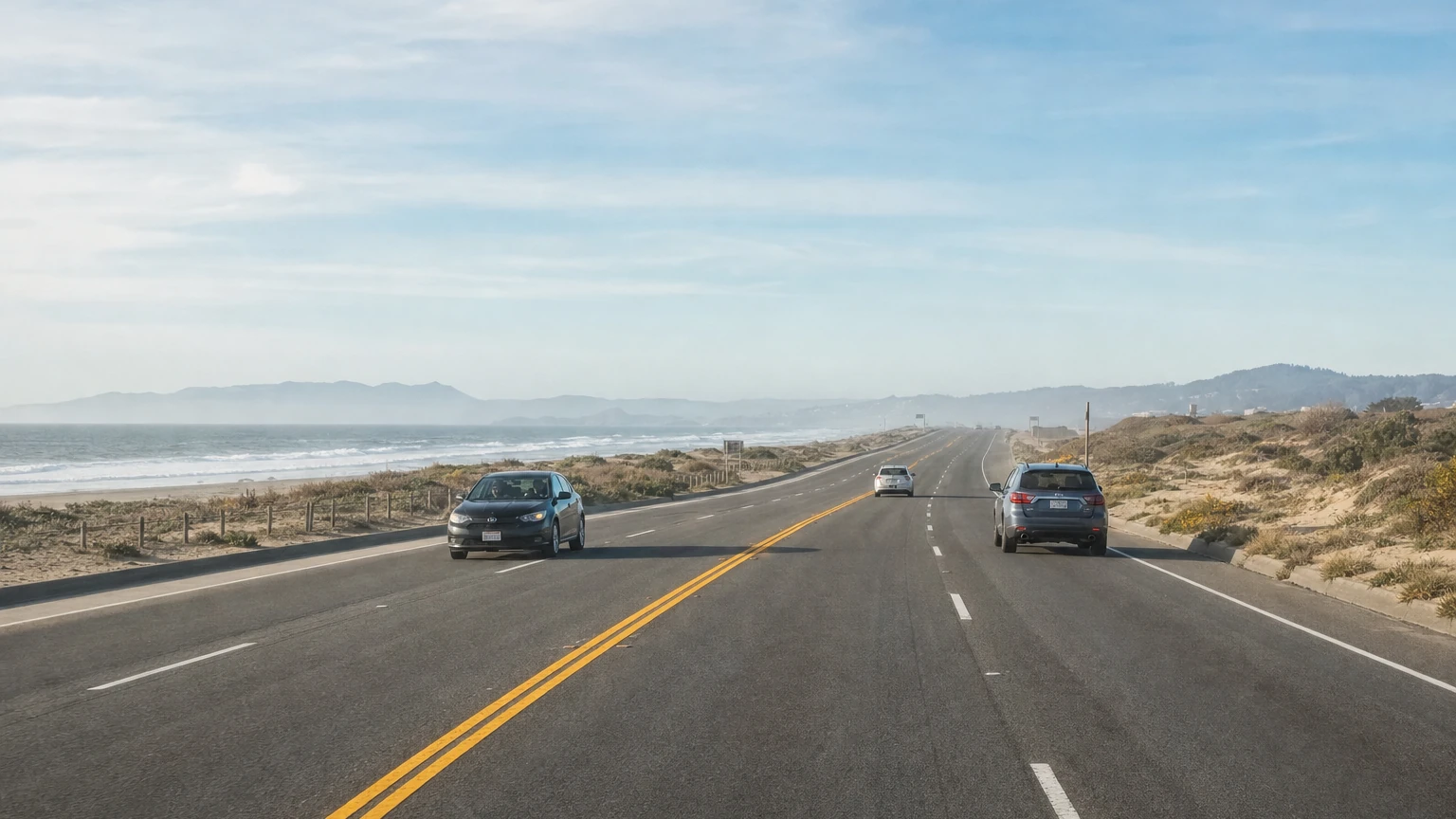
A San Francisco judge has cleared the way for voters to decide whether cars should return to the Upper Great Highway on weekdays. He did not decide that the campaign claims used to qualify Proposition G were true, and he did not order a single car back onto Sunset Dunes.
If Prop G wins a simple majority on November 3, it would restore weekday private-vehicle access on the roughly two-mile segment between Lincoln Way and Sloat Boulevard, while keeping the roadway closed to private cars from Friday at 6 p.m. until Monday at 4 a.m. and on holidays.
What the court actually decided
Friends of Sunset Dunes challenged statements in the petition used to qualify Prop G. California courts can invalidate a petition where factual assertions are not simply debatable or exaggerated but false beyond dispute. Judge Harold E. Kahn concluded the challenged language did not meet that unusually high threshold.
That is narrower than a finding that every disputed assertion was correct. The court did not decide, for example, that the Upper Great Highway is a designated evacuation route or that weekday recreational use is minimal. It decided voters should not be deprived of a vote because the disputed political claims were not demonstrably false beyond dispute.
2020 → 2022 → Prop K 2024 → Prop G 2026
2020: San Francisco closed the Upper Great Highway to private vehicles during the COVID emergency, creating recreational space along Ocean Beach.
2021–2022: Weekday driving returned while weekends and holidays remained recreational. Ordinance 258-22 established a pilot weekend-and-holiday restriction through the end of 2025.
2022: Voters rejected Proposition I, which would have required vehicle access on the Great Highway and also affected the southern extension.
2024: Proposition K permanently closed the Lincoln-to-Sloat segment to private motor vehicles and passed 54.73% to 45.27%.
2025: Sunset Dunes opened as a full-time coastal park.
2026: Opponents gathered signatures for Proposition G, which would recreate a weekday-road/weekend-park compromise. The court challenge failed at the trial-court level, leaving the measure on the November ballot.
What voters cannot restore
The southern Great Highway is a separate story. The segment south of Sloat is being retired as part of the Ocean Beach Climate Change Adaptation Project because shoreline erosion threatens critical wastewater infrastructure. Even if Prop G passes, drivers would leave the coast at Sloat rather than continue south on the old route toward Skyline Boulevard.
Why a Yes vote would not reopen the road the next morning
Prop G’s own text recognizes that implementation may require approvals under the California Coastal Act. Reopening also requires physical work: park features would need to be removed or relocated, lane markings restored and traffic infrastructure installed.
The Controller has estimated roughly $9.8 million in upfront costs, including traffic signals at eight intersections, plus recurring annual costs. Those estimates do not automatically appropriate money.
Sunset Dunes now has real usage data
The policy debate is no longer about an empty pandemic roadway. Recreation and Park counters recorded more than 1.7 million visits during the park’s first year. Weekends were busier per day, but weekday visits made up a substantial share of total use.
That does not answer whether the road is more valuable for transportation or recreation. It does mean voters can now weigh actual park usage against the case for restoring weekday driving.
The ballot choice is narrower than “park or highway”
A Yes vote means a weekday road and weekend/holiday park on Lincoln-to-Sloat. A No vote keeps the full-time Sunset Dunes configuration. Neither outcome recreates the pre-pandemic coastal drive, because the route south of Sloat is not coming back.