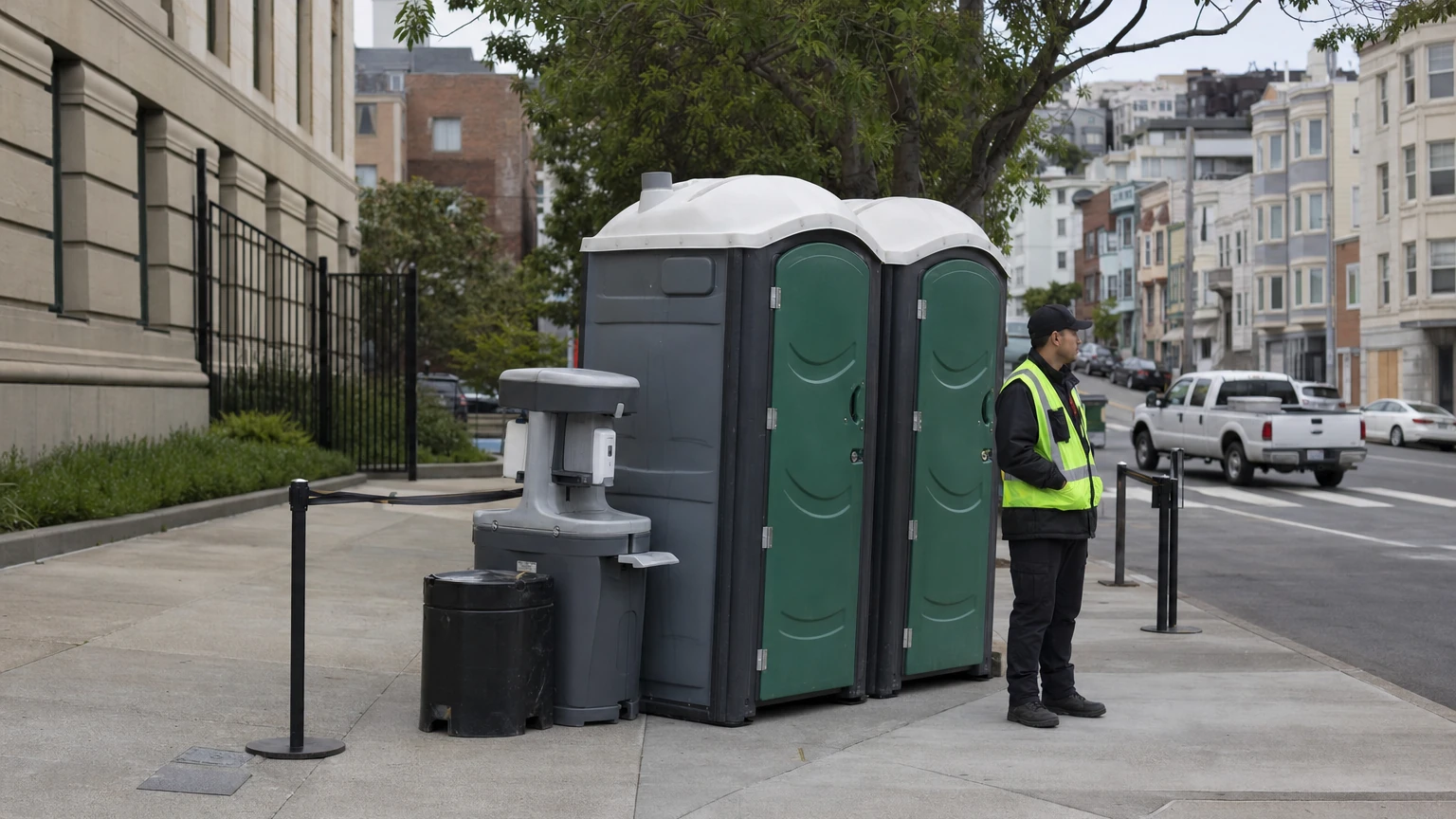
San Francisco Public Works says one consequence of cutting the city’s staffed public-restroom network showed up quickly in a revealing place: requests to clean biological waste from the streets.
In its FY2026-27 and FY2027-28 budget submission, Public Works asked for $9.3 million to restore the Pit Stop program from 16 locations to 30. The department said 311 “steamer” requests involving biowaste had spiked 21% after the reduction in Pit Stop locations.
The full restoration did not make the adopted budget. Public Works’ approved-budget materials instead identify $300,000 in new funding for a District 6 Pit Stop.
San Francisco now lists 16 Pit Stop locations
The current Public Works directory lists 16 staffed Pit Stops across nine neighborhoods. Four are in the Mission and four in the Tenderloin, with additional sites in Mid-Market, Civic Center, the Castro, SoMa, the Embarcadero, Ocean Beach and the Outer Sunset.
Only three are listed as open 24 hours: U.N. Plaza, 16th and Mission, and 474 O’Farrell Street. Eddy and Larkin provides an unusually useful overnight window from 6 p.m. to 6 a.m. Most other Pit Stops close by the evening.
The 21% figure needs a careful label
The city’s open 311 data uses the category “Human or Animal Waste.” San Francisco changed the label because individual 311 records do not reliably distinguish human from animal waste. That means it would be wrong to map every record and call it “human feces.” Public Works’ 21% budget figure is its own narrower operational measure of “steamer” requests involving biowaste.
A 2025 Budget and Legislative Analyst audit found feces on roughly 30% of evaluated routes, with particularly high prevalence in SoMa, the Tenderloin, Castro/Upper Market and the Mission. The audit also concluded that cleaning alone was not enough to durably manage sidewalk waste in several study areas.
Why bathrooms matter beyond homelessness policy
A functioning public bathroom is mundane infrastructure until someone needs one. The practical problem affects delivery drivers, tourists, transit riders, night-shift workers, parents, older residents and people experiencing homelessness. A restroom pin that closes at 5 p.m. is not equivalent to a 24-hour facility.
That is why SF News Today has built a companion guide: where to find a bathroom in San Francisco, including late-night customer options.
The high-tech replacement has not filled the gap
The automated AmeniPod at Embarcadero Plaza was supposed to point toward a next generation of city toilets. Reporting based on Public Works records has documented more than 200 maintenance issues or complaints, and the broader rollout has slipped toward 2027. That makes the remaining staffed network more important in the near term.
A $9.3 million question the city has already partly answered
Public Works’ budget request is notable because the department did not merely say more toilets would be nice. It linked a program reduction to a measurable sanitation increase, then asked to reverse the reduction.
Whether restoring all 30 locations is the best use of $9.3 million is a budget choice. But the city’s own evidence makes one point hard to avoid: reducing public restroom access was not cost-free.