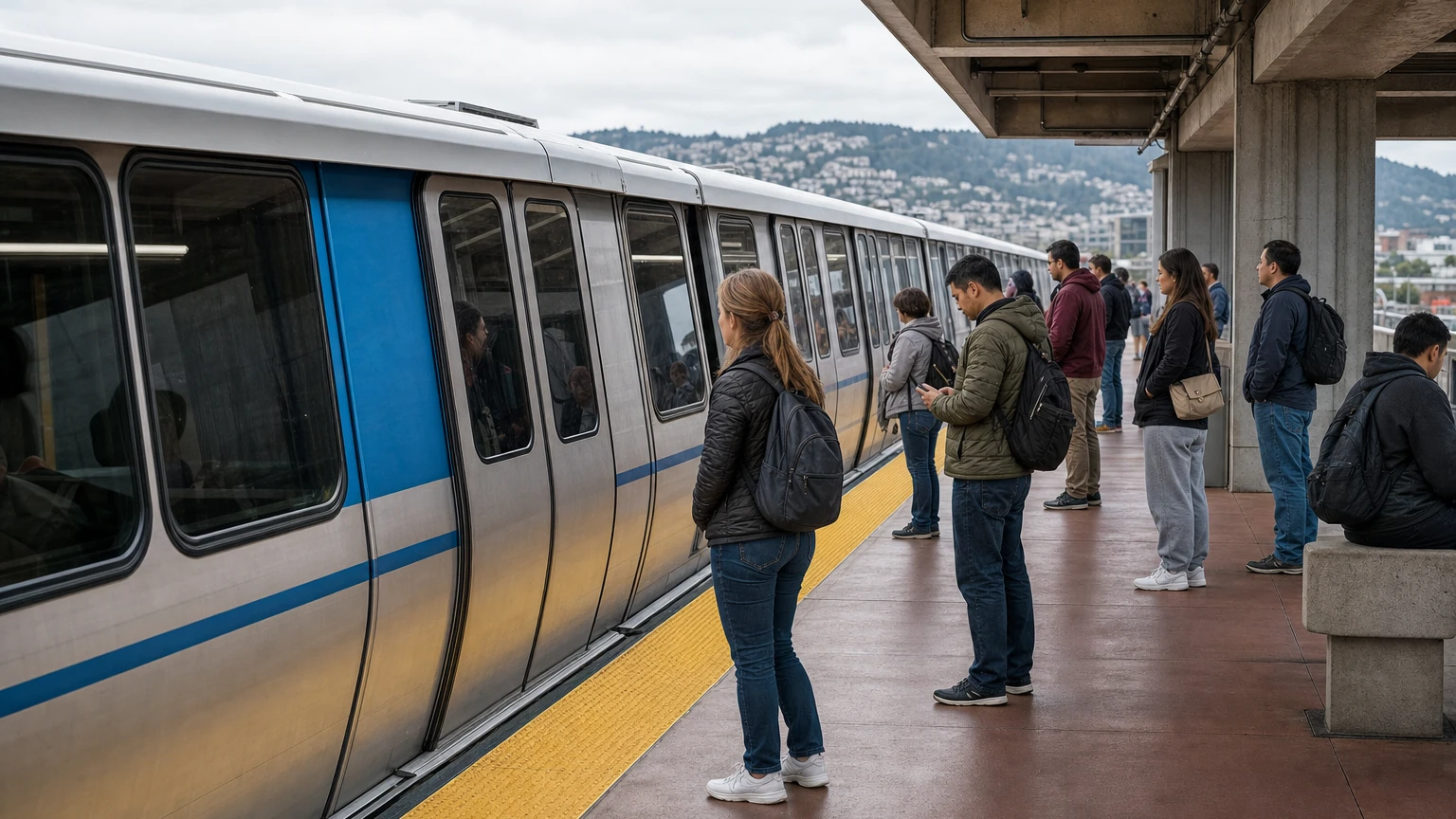
SAN FRANCISCO — If a BART train suddenly slows down and stops Thursday morning, riders should not immediately assume there has been an earthquake.
BART says it will deliberately trigger its ShakeAlert earthquake early warning system at 10:15 a.m. Thursday, Oct. 15 as part of the 2026 International Great ShakeOut. Every BART train is expected to automatically slow to 27 mph and then come to a very brief stop before continuing.
The agency will also make a systemwide public announcement about earthquake preparedness. BART has not published a precise duration for the stop or a systemwide delay estimate, so riders with a time-sensitive connection should allow a little extra margin around 10:15 a.m.
Why will BART trains stop at 10:15 a.m. Thursday?
It is a scheduled earthquake drill, not a planned service shutdown.
BART is testing whether the automatic ShakeAlert connection, train-control response and internal emergency communications work as intended. The drill is synchronized with the Great ShakeOut, which is held on the third Thursday of October and is centered on earthquake preparedness.
For riders, the visible part is simple: trains slow, pause briefly and then continue. Behind the scenes, BART says its Operations Control Center will observe earthquake alarms and train-control systems, employees will test internal communications, and emergency-response teams will conduct simulated damage inspections.
Will every BART train slow to 27 mph?
Yes. BART's Oct. 15 drill notice says all trains will automatically slow to 27 mph once staff trigger the system.
That speed is not arbitrary. BART's earthquake-safety guidance says its early-warning servers continuously receive seismic data and automatically send a speed-restriction command when the system's shaking threshold is reached. A train operating at 70 mph takes about 20 seconds to slow to 27 mph, according to BART.
The purpose is to remove the delay of waiting for a person to recognize an alert and issue a manual command. Depending on where a real earthquake begins, an automated slowdown can start before the strongest shaking reaches the railway.
How long will BART trains stop?
BART describes Thursday's planned pause only as a “very brief stop.” It has not given a number of seconds or minutes.
That makes this drill different from a major real-earthquake response. BART's emergency plan can hold trains while the control center checks alarms, shaking intensity and reports of damage; operators may then move at reduced speed while visually inspecting track.
For Thursday's exercise, BART has announced a brief stop followed by continued service.
What should riders do during the ShakeAlert drill?
BART has not announced a passenger evacuation as part of Thursday's drill. Riders should listen for the systemwide announcement and follow any instructions from train operators.
If there is actual shaking or a real emergency at the same time, treat that as real. BART's standing earthquake guidance tells riders on trains to sit down if possible or grab a handhold and follow staff instructions.
Has BART's earthquake warning system ever activated for a real quake?
Yes. BART says a magnitude 4.0 Oakland earthquake in August 2015 triggered the system and trains automatically slowed. During the 2014 South Napa earthquake, the warning system also initiated BART's automated response, although trains were not running at that early-morning hour.
USGS describes BART as an early adopter of ShakeAlert and uses transit as an example of how earthquake alerts can trigger automated protective actions rather than relying only on phone notifications.
What else is BART testing on Oct. 15?
The train slowdown is only the part passengers are likely to notice.
BART says its Emergency Response Team will simulate structural inspections at all 50 stations, checking features such as walkways, support structures, elevators, escalators, power, signage and possible water intrusion. The agency says the exercise is designed to build the “muscle memory” needed to inspect the system and restore service after a damaging earthquake.
The Great ShakeOut itself is scheduled for 10:15 a.m. on Oct. 15, 2026 in California, matching BART's trigger time.