On March 5, 2024, San Francisco voters made a choice. By roughly 54% to 46%, they approved Proposition E, a broad measure that changed police policy and explicitly gave the San Francisco Police Department authority to use drones.
There is no point pretending the drones were hidden. They were not.
The official voter guide said police could use uncrewed aerial vehicles along with or instead of vehicle pursuits and “to assist with active criminal investigations.” The measure also said SFPD should use technology to the maximum extent possible to improve efficiency and fight crime, subject to privacy and civil-liberties protections.
But a ballot gives voters legal language, not a demonstration.
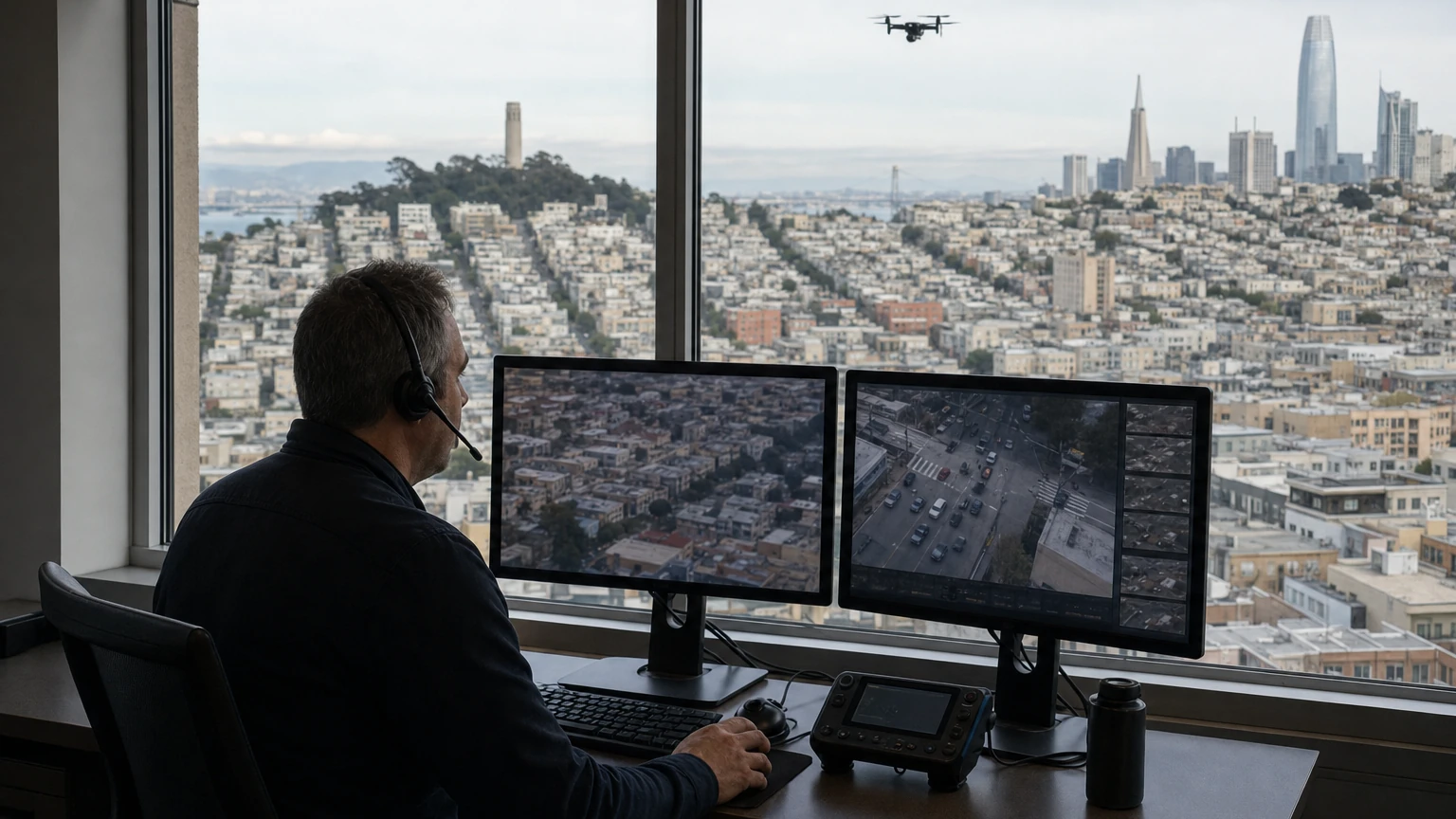
Two years later, the system that grew from that authority is easier to see. SFPD now operates a 24-hour Real Time Investigation Center, uses automated license-plate-reader alerts and runs Drone as First Responder operations. In several cases described by SFPD itself, those systems have worked together to follow vehicles and people across San Francisco.
What police drone tracking looks like now
On July 29, according to SFPD's account of a burglary investigation, officers in RTIC saw a vehicle linked to burglaries entering San Francisco from the East Bay. RTIC dispatched a Drone as First Responder and alerted plainclothes officers.
SFPD says the drone operator and officers then conducted coordinated surveillance while the vehicle drove through the city. Police watched the driver change license plates. They watched two occupants put on construction vests. They watched the pair enter a building under construction. When a third suspect fled, the drone continued following the vehicle until it reached Aquatic Park.
That same day, in an unrelated narcotics investigation, SFPD says a DFR operator tracked a suspect vehicle into San Francisco and watched five people exit it and board a Muni bus near Second and Mission streets. Officers then boarded the bus and detained them.
In May, police investigating chain-snatching robberies located a Honda Pilot believed to be involved in the series. SFPD says plainclothes officers began surveillance with DFR assistance. One occupant later boarded a Muni bus; the vehicle followed the bus, and the surveillance continued.
And on April 30, SFPD published a release with a headline that captured the new capability plainly: “SFPD Drone Tracks Robbery Suspects Across San Francisco.”
The department's public flight-log dataset now contains 6,851 flight records, covering deployed small police drones beginning May 16, 2024, through the latest published monthly data as of July 30, 2026. The dataset records the date, case or event number, call type, flight duration, reason, generalized location, neighborhood and district.
SFPD says this is a public-safety system. That is important context. Drones can reduce the need for dangerous vehicle pursuits, give officers information before entering a volatile scene and help track suspects without putting a police car directly behind them.
The arrests described above are not abstractions. Robberies, burglaries and narcotics trafficking have victims. A voter could look at those examples and conclude that this is exactly what Proposition E was meant to accomplish.
But another voter might look at the same system and ask whether the words assist with active criminal investigations adequately conveyed the surveillance capability that would exist two years later.
Would the vote still be 54–46?
That is the question this story cannot answer — and should not pretend to answer.
There is no reliable evidence showing how the 120,000-plus Yes voters would vote if Proposition E were placed before them again with video examples of 2026 drone tracking. It is tempting to imagine a 54–46 result becoming 46–54 in the other direction. That would be speculation.
Maybe the measure would win by more today. Maybe voters who have seen drones replace car chases would be enthusiastic about them. Maybe the result would barely move.
Still, a nine-point margin is close enough to make the democratic question meaningful: what, exactly, did voters understand they were authorizing?
Imagine a ballot presentation that did not merely say “drones.” Imagine voters were shown a target vehicle triggering an automated license-plate alert, a 24-hour intelligence center receiving that alert, a police drone taking over observation and the target being followed through city streets until occupants left a car and boarded public transit.
Would everybody who voted Yes still vote Yes?
We cannot know. But that is different from saying the question is unfair.
The strongest police argument: you were in public
Police have a powerful constitutional argument for much of this activity. If a person drives on a public road, walks on a public sidewalk or boards a bus, those acts can be seen by other people. The Fourth Amendment generally does not give someone a right to be invisible in public.
The Supreme Court's older aerial-surveillance cases are particularly favorable to law enforcement. In California v. Ciraolo, officers investigating suspected marijuana cultivation flew over a fenced backyard in a plane at about 1,000 feet and observed marijuana plants. The Court held that the aerial observation did not violate the Fourth Amendment. In Florida v. Riley, police observed a greenhouse from a helicopter at roughly 400 feet and again prevailed.
The public-view argument is straightforward: a police officer may see what any member of the public could lawfully see.
But modern surveillance technology puts pressure on the meaning of the word could.
Kyllo's warning about giving police superhuman senses
One of the most useful Supreme Court cases for thinking about that problem began, like Ciraolo, with suspected marijuana cultivation.
In Kyllo v. United States, federal agents suspected Danny Kyllo of growing marijuana inside his Oregon home. Indoor cultivation often used powerful lamps. Agents stood outside and aimed a thermal imager at the house to detect patterns of heat.
The device detected infrared radiation that was not visible to the naked eye. It converted that information into an image showing relative warmth.
The Supreme Court held that using sense-enhancing technology not in general public use to obtain information about the interior of a home that could not otherwise have been obtained without physical intrusion was a search.
The home was central to the decision; homes receive the Fourth Amendment's strongest protection. It would be wrong to say Kyllo itself makes police drone tracking on public streets unconstitutional.
But its reasoning exposes a weakness in an unlimited version of the “public view” argument.
The agents in Kyllo were standing somewhere they could lawfully stand. The problem was what their machine allowed them to perceive from there. The Court was unwilling to let constitutional protection simply shrink each time technology gave government a new sense.
A thermal imager gives an officer a kind of vision a human being does not have.
An integrated surveillance network can give police something else a human being does not have: a kind of practical omnipresence.
A normal officer cannot stand at the Bay Bridge and scan every plate entering San Francisco, instantly appear above a target in another neighborhood, follow it without getting tired or losing sight of it, watch its occupants get out, switch attention to their movements, coordinate with cameras elsewhere and preserve a timestamped visual record.
For that, the hypothetical officer would need to be Superman.
Or the officer needs computers, cameras, databases, license-plate readers, a real-time center and drones.
Public does not necessarily mean trackable without limit
Later Supreme Court cases make the distinction even clearer.
In Carpenter v. United States, the Court said a person does not surrender all Fourth Amendment protection simply by venturing into public. The Court recognized a privacy interest in the whole of a person's physical movements.
The insight is ordinary, not technical.
One stranger might see you enter a church. Another might see you leave a psychiatrist's office. Someone else may notice you attend a political meeting. A fourth person might see you arrive at a romantic partner's apartment.
Every observation may occur from public space.
But no ordinary observer sees all of them, links them to the same person, timestamps them, stores them and makes the resulting history searchable.
That is why the constitutional debate over modern surveillance cannot always end with the sentence: you were in public.
The harder question is whether technology transforms a collection of ordinary observations into something qualitatively different.
Proposition E did not erase privacy limits
The text voters approved recognized that tension. Proposition E says SFPD should use technology to improve effectiveness, but it also says that use remains subject to policies protecting privacy and civil liberties. Public footage generally cannot be retained beyond 30 days without the required determination tied to an open criminal investigation.
SFPD's own drone policy says drone use must conform with federal, state and local law and protect constitutional rights. Operators are told to minimize collection involving uninvolved people and, unless legally authorized, avoid recording places where there is a reasonable expectation of privacy.
The policy also recognizes that drones can fly over people only subject to operational and safety constraints. It tells operators not to fly lower or closer to people than necessary when such operations are needed to safeguard life.
None of that proves the current program violates the Constitution. It does show that Proposition E was never a blank check.
What voters authorized, and what technology became
San Franciscans did vote for police drones.
Any account of Proposition E that obscures that fact would itself mislead readers.
But voters also voted at a particular moment in the development of the program. SFPD says its first phase began with six drones. Today the important thing is not simply the number of aircraft. It is the way the aircraft can work with a surveillance system around them.
RTIC is now staffed around the clock. A department notice says it provides citywide investigative and Drone as First Responder support. The flight-log database documents thousands of deployments. SFPD's own case descriptions show drones conducting coordinated surveillance as targets move through the city.
That is not necessarily an abuse of Proposition E. It may be the natural implementation of it.
But democratic consent is worth revisiting when a technology changes from a noun on a ballot to a working system in the sky.
Maybe 54–46 remains 54–46.
Maybe it becomes 60–40.
Maybe it flips.
We do not know.
What we do know is that San Francisco can now see what Proposition E means in practice in a way voters could not see on March 5, 2024.
And perhaps that deserves a second question — not necessarily another ballot measure, but a public one:
When voters said yes to police drones, how much surveillance did they believe they were saying yes to?