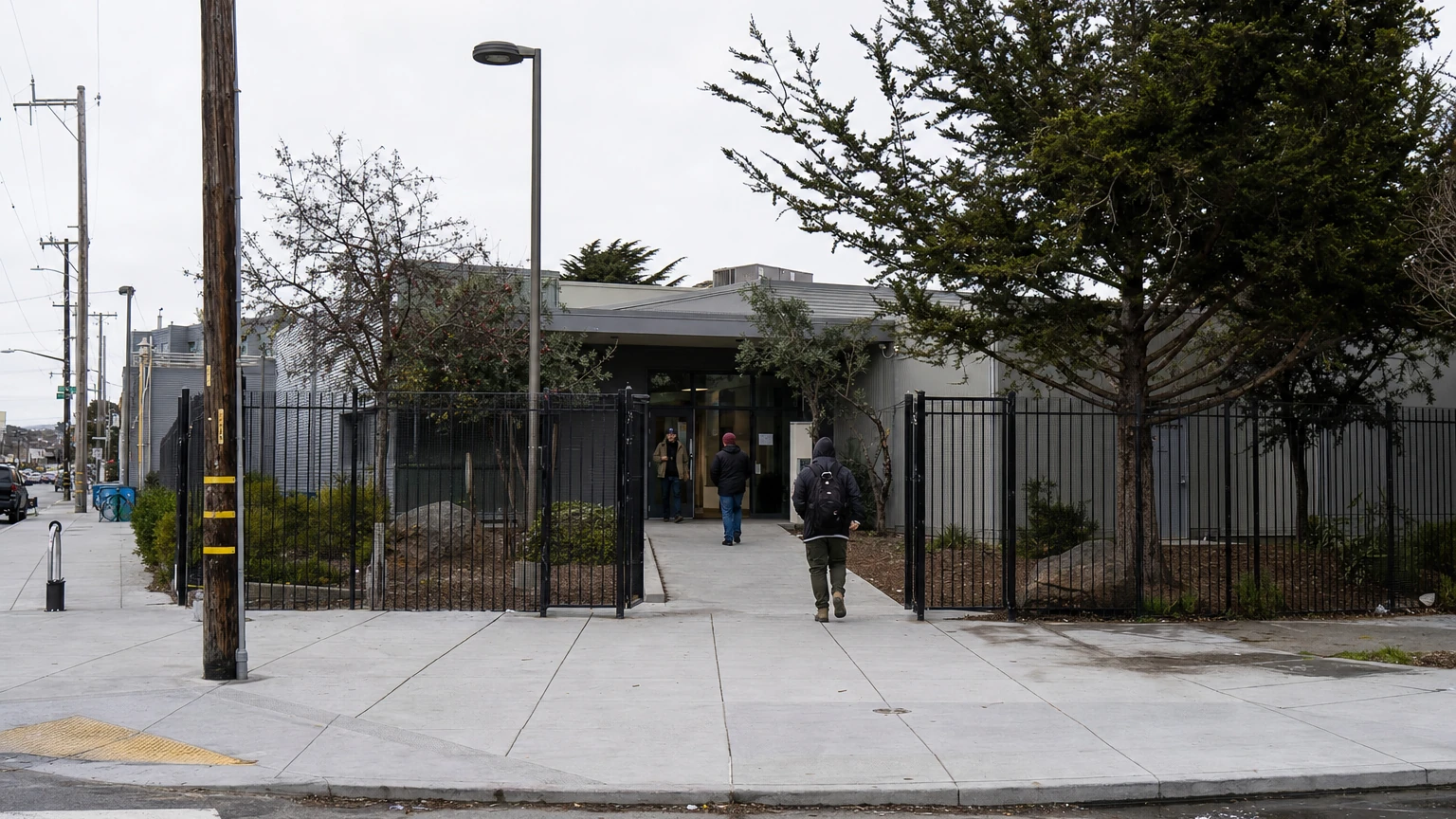
When San Francisco police announced the arrests of two workers at the Bayshore Navigation Center last week, most of the attention understandably went to what police say happened inside and around the homeless shelter on the night an officer was shot.
There is another public-interest question underneath the criminal case: what operating and oversight agreement governs the shelter now?
San Francisco previously authorized up to $25,071,113 for Five Keys Schools and Programs to provide shelter and support services at the Bayshore Navigation Center, at 125 Bayshore Boulevard. That grant ran through June 30, 2026. Separately, the Board of Supervisors approved a new 10-year lease for the Bayshore property, anticipated to begin July 1, at an initial annual rent of $655,200 with 3% yearly increases and two five-year extension options.
That does not establish that no successor agreement exists. A contract or grant may have been executed under authority that did not require a new Board resolution, may sit in another city contracting system, or may not yet be readily surfaced through the records reviewed here. It does make the current arrangement worth clarifying.
What police allege happened at 125 Bayshore
The underlying case began late on May 31. According to SFPD, officers attempted to stop a robbery suspect near Mission and First streets. After a pursuit and crash near Bayshore Boulevard and Jerrold Avenue, police say the driver, later identified as Norris Reed III, fired at officers and struck one officer multiple times before fleeing toward the navigation center.
Reed was eventually arrested at the center. Police said officers recovered two firearms from his waistband.
SFPD alleges surveillance video shows employee Oliver Barcenas giving Reed clothing to help conceal his identity while knowing Reed had a firearm. Police separately allege Erika Porter gave officers false information while they were searching for Reed. Both employees face felony allegations. The allegations have not been proved in court.
Five Keys has offered additional context. In comments reported by Mission Local, CEO Steve Good said staff described Reed as displaying two firearms and warning them not to call police, creating a situation in which employees were trying to keep residents safe and evacuate the shelter. That account does not resolve the criminal allegations, but it is relevant to the operational questions the city now faces.
What San Francisco was paying Five Keys to provide
Five Keys had operated Bayshore since the navigation center opened in 2018. The grant was expanded and extended over time, eventually reaching its $25.1 million ceiling through June 2026. The Board resolution authorizing the amended grant and related legislative materials describe a 128-bed program serving adults referred through San Francisco's shelter-placement system.
The agreement covered intake, needs assessments, case management, benefits assistance, wellness checks, referrals and exit planning. It also covered emergency-shelter operations such as reservation coordination, safe and clean sleeping accommodations, meals, toilets and showers.
Those documents are not, on their face, a detailed armed-intruder protocol. The publicly available material reviewed by SF News Today does not answer exactly what employees were instructed to do if an armed person entered the site, how they were required to communicate with law enforcement while protecting residents, or what incident-escalation rules applied.
Prior monitoring did not flag the center as failing its program goals
There is useful historical context that cuts against assuming the center had previously been viewed as badly managed. Board materials summarizing a June 2023 HSH program-monitoring visit said Five Keys had met the service and outcome objectives then being monitored under the grant.
That does not answer what happened on May 31. It does show why the right question is not simply whether the city had ever monitored the contractor, but whether its oversight rules and emergency procedures were adequate for an extreme event.
The city has committed to the Bayshore property for another decade
The new lease approved by the Board covers roughly 31,200 square feet of property and 22,965 square feet of buildings. Its stated purpose is continued use by the Department of Homelessness and Supportive Housing for emergency shelter. The initial 10-year term can be followed by two additional five-year options.
The initial base rent works out to about $54,600 a month, before contractual annual increases.
That long-term commitment makes the unanswered operating questions more important, not less.
What San Francisco should clarify now
The immediate questions are straightforward: Who holds the current operations agreement? What security and emergency-response rules govern the Bayshore Navigation Center today? Did HSH conduct an incident review after May 31? Did that review produce any changes? And what does the city expect shelter employees to do when immediate resident safety and cooperation with police collide?
Those questions do not assume guilt by the workers and do not presume that the contractor breached its agreement. They are basic accountability questions about a publicly funded shelter the city has committed to keeping open for years.
San Francisco residents, taxpayers and the people who sleep at Bayshore are entitled to know how the facility is supposed to work when something goes seriously wrong.