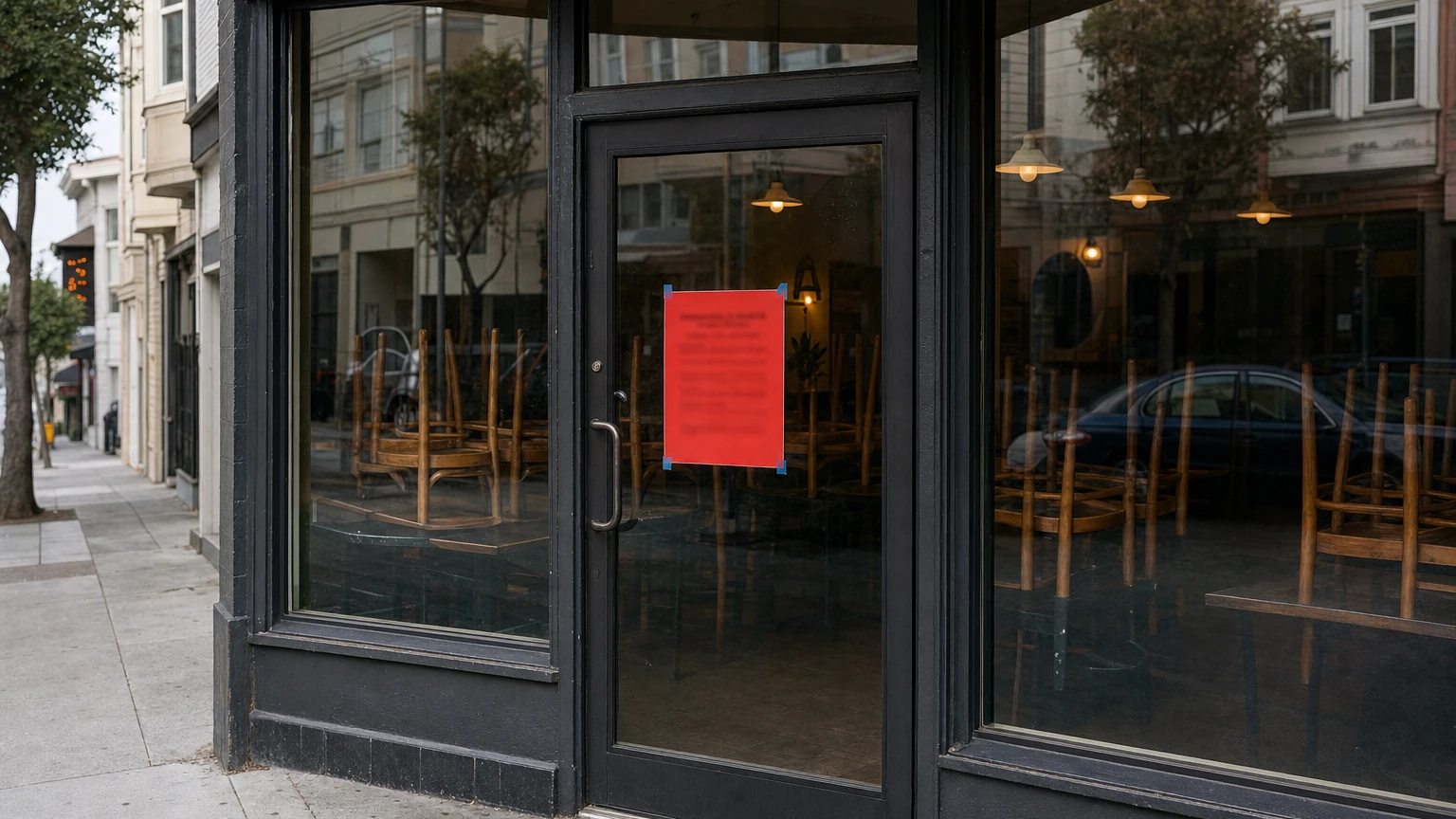
Two San Francisco food businesses received red closure results in the latest published batch of health-inspection records reviewed by SF News Today.
The records show red results for Mason Deli and Market at 39 Mason Street and Noriega Cafe Inc. at 1245 Noriega Street, both on August 14.
That sounds straightforward until you look at other inspections in the same batch. Some establishments received green Pass results even though the published record lists violations that sound serious on first reading.
The difference is important because San Francisco's inspection system is not a scorecard where the business with the most violations automatically loses. Severity, whether a major condition can be corrected immediately and the final placard result matter more than the raw count.
Mason Deli and Market: red in the latest published record
The city's Health Inspection Scores dataset lists an August 14 Closure result for Mason Deli and Market at 39 Mason Street.
The published inspection record includes requirements involving approved and properly maintained equipment, the condition and cleanliness of the premises, and maintaining the facility to prevent the entrance and harboring of rodents, insects and other vermin.
The key phrase is “latest published record.” SF News Today is not saying the deli is permanently closed and is not claiming the conditions identified on August 14 remain there today. A red health placard is temporary enforcement: a business can reopen after unsafe conditions are corrected and the Department of Public Health permits it to do so.
Noriega Cafe: one published issue can still be consequential
Noriega Cafe Inc. at 1245 Noriega Street also appears with an August 14 Closure result in the latest published batch reviewed for this story.
The record concerns the need for an approved Hazard Analysis and Critical Control Point, or HACCP, plan for certain potentially hazardous foods prepared or packaged using reduced-oxygen methods for extended periods in connection with smoking or curing.
Reduced-oxygen food preparation can create specialized food-safety risks if it is not performed under an approved process. That is a useful example of why one regulatory problem can be significant enough to stop an operation while several lower-level or immediately corrected issues may not be.
How can a business have violations and still get a green pass?
San Francisco DPH's placard explainer makes the system clearer.
| Placard | What it means |
|---|---|
| Green — Pass | The establishment can operate. A major violation may still have been observed if it was corrected during the inspection. |
| Yellow — Conditional Pass | Two or more major violations were observed but corrected during the routine inspection; a reinspection follows. |
| Red — Closed | Health hazards or major violations existed that could not be corrected immediately. The business must correct them before reopening. |
That is why a list of violation counts alone can be badly misleading.
A green pass is the department's conclusion
The same published batch includes establishments that received a green Pass while still having individual violation descriptions in the record. Those descriptions may concern vermin control, hot water, temperature control, sanitation or other requirements.
If the final placard is green, the official result is Pass. Readers should not convert a scary-sounding line item into a claim that the restaurant was ordered closed.
Likewise, historical inspection records should not be presented as current conditions without checking what happened at the next inspection.
Why the open-data lag changes how a closure should be written
The city's open dataset is extremely useful for pattern reporting because it standardizes establishment names, addresses, inspection dates, violations and placard outcomes. It is less suitable as a minute-by-minute “open or closed right now” service because the public file updates periodically rather than after every inspector visit.
That means two statements that sound similar are actually very different. “DPH closed this business on Aug. 14” describes a historical enforcement action in the published record. “This business is closed today” is a live-status claim that requires a newer inspection, the current placard, a direct business update or another timely source.
Keeping those two claims separate protects readers from stale information and protects restaurants from having a corrected problem presented as though it were still happening.
Why we are not publishing a “dirtiest restaurants” ranking
There is an obvious clickbait version of this dataset: count violations, rank the businesses and label the top entries “San Francisco's dirtiest restaurants.”
It would be misleading.
One business can receive a red closure over one consequential regulatory problem. Another can have several listed violations and still receive a Pass because the conditions were corrected or did not require closure.
A meaningful health-inspection story therefore has to show the inspection date, placard outcome, nature of the finding and what happened at reinspection.
What readers should check before deciding where to eat
Look at the placard displayed at the establishment and the most recent inspection record, not just an old closure that remains indexed on the web.
If Mason Deli and Market or Noriega Cafe received a new inspection after the city's latest open-data refresh, that newer result should control how their current status is described. SF News Today will update this page when a later published inspection changes the record.
That is how a public-health database becomes useful reporting instead of a permanent blacklist.