SAN FRANCISCO — A run of electrical failures across San Francisco this week is raising a larger question than when the lights will come back on.
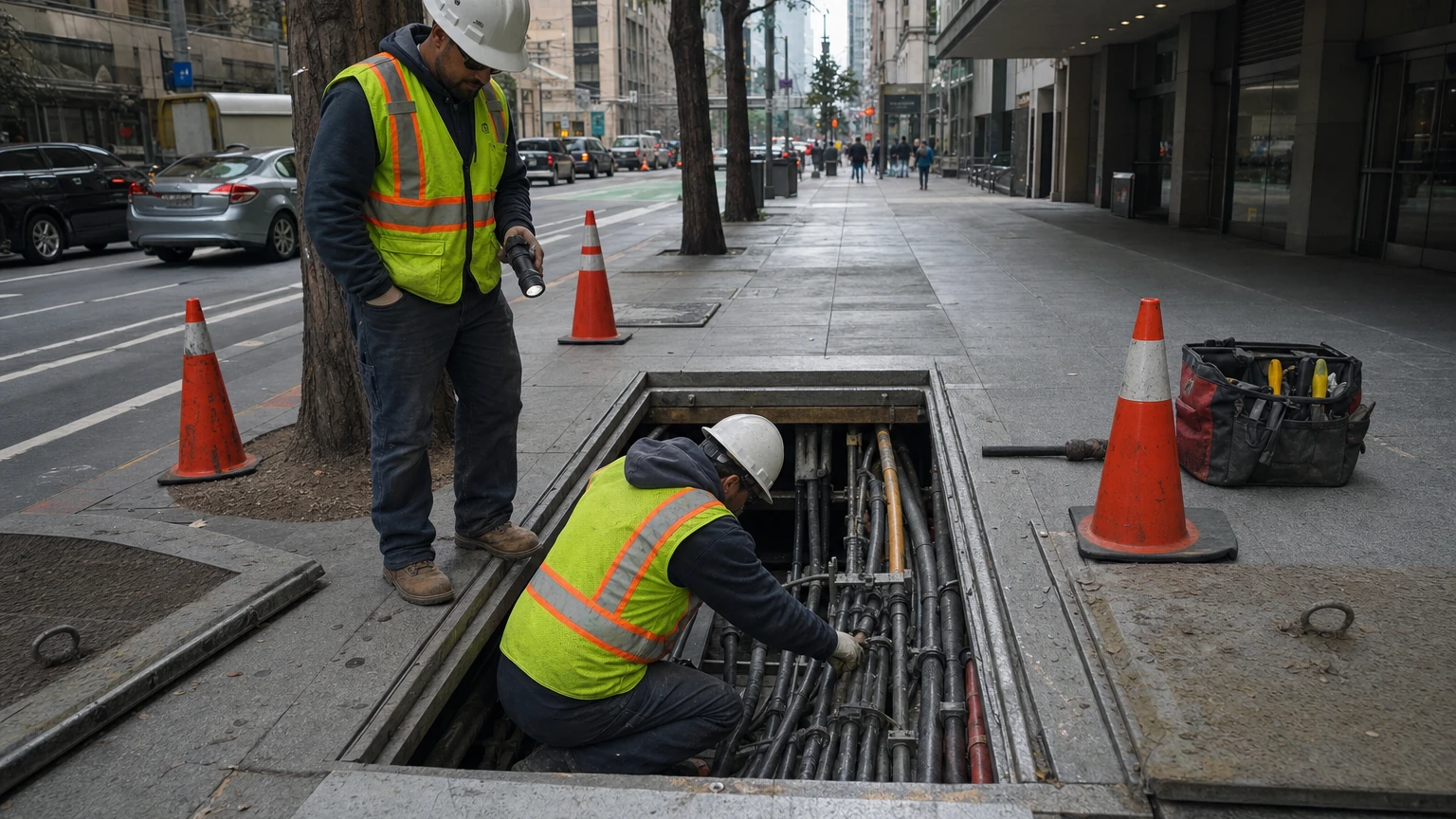
Pacific Gas and Electric has told California regulators for years that many network cables in San Francisco and Oakland were aging and approaching the end of their service lives. The utility has also told regulators that failures of network cables can cause outages, equipment damage, smoke, fires, explosions and displaced manhole covers.
PG&E began a systematic network-cable replacement program in San Francisco in 2012. But a later filing shows that the program was reprioritized. In its 2027 General Rate Case materials, PG&E says systematic network-cable replacement work associated with the 2023–26 rate-case period was deferred and is expected to ramp up again beginning in 2029, after wildfire-related commitments.
There is no public evidence at this point that deferred replacement work caused any of this week’s outages, or that the four incidents were all connected. The sharper accountability question is whether the pace of replacement has kept up with risks PG&E itself identified.
Four electrical incidents in three days
The sequence began Wednesday morning. At about 6:42 a.m. Sept. 30, an unplanned outage hit the Ferry Building and surrounding waterfront. PG&E said roughly 455 customers were affected. Businesses lost power and some traffic and pedestrian signals stopped working. The cause remained under investigation when the outage was reported.

Early Thursday, Oct. 1, the more dramatic incident occurred near California and Front streets in the Financial District. Four underground electrical vaults experienced eruptions, prompting evacuations, street closures and a shelter-in-place order. PG&E later described the underlying problem as “an issue related to an underground cable.”
SF News Today separately covered the California and Front incident as it unfolded. The age, type and replacement status of the cable involved have not been publicly established.

Later Thursday afternoon, a separate outage affected about 2,665 customers around Cathedral Hill, Lower Nob Hill, Japantown and the Western Addition. PG&E attributed that outage to a transformer with low oil.

Then on Friday evening, Oct. 2, power went out around Fisherman’s Wharf, Pier 39, North Beach and Russian Hill. PG&E said a report of a downed wire required about 1,300 customers to be shut off so crews could make an urgent repair; roughly another 300 customers lost service during restoration work.

Those stated causes are not the same. One incident involved an underground cable issue, another a transformer with low oil and another a reported downed wire. A cluster in time is not evidence of a single cause.
PG&E has warned regulators about aging network cables for years
In testimony supporting its 2023 General Rate Case, PG&E described a network-cable replacement project covering primary and secondary cables in San Francisco and Oakland. PG&E said primary and secondary cable failures can produce electrical outages, equipment damage, explosions, smoke and fires, with added risk because equipment is beneath dense urban areas with significant pedestrian traffic.
The utility also reported 145 network cable and splice failures in San Francisco and Oakland since 2008 and said additional failures could be expected as the facilities aged.
In the CPUC’s decision on that rate case, the Commission summarized PG&E’s evidence by noting that many existing primary and secondary network cables dated from the 1920s through the 1960s and were reaching the end of their service lives. PG&E argued that proactive replacement was important for safety and reliability, and the CPUC found a proactive replacement program reasonable.
What was PG&E planning to replace?
PG&E’s 2023 rate-case workpapers forecast a systematic program replacing about 56,889 circuit feet of network cable per year in 2023, 2024, 2025 and 2026. The 2023 forecast cost was about $30.9 million, with annual forecast costs increasing in later years.
The workpapers described the program as a way to reduce safety risk, minimize service outages and maintain aging network assets.
Then the systematic replacement work was reprioritized
The CPUC’s Public Advocates Office later highlighted a substantial gap between that forecast and reported work. Reviewing PG&E’s 2023 Risk Spending Accountability Report, Cal Advocates said PG&E reported completing none of the 56,889 circuit feet associated with the 2023 authorization.
PG&E explained that the program had become a lower priority than emergency cable replacements, other underground and network maintenance, network transformers and capacity work. The utility also said the activity had changed from a “mitigation” in its earlier risk model to a “control” in its 2024 risk assessment.
PG&E’s later 2027 General Rate Case filing expands the picture across the 2023–26 period. Its deferred-work table lists 227,557 circuit feet and $135.552 million in imputed units and costs for network-cable replacement, compared with zero circuit feet and $644,000 in recorded or forecast work and spending in that table.
PG&E says it expects to spend approximately $134.9 million less than the imputed amount because work was reprioritized to emergency replacements, capacity improvements and pole replacement. The filing says systematic network-cable replacement is expected to ramp up again beginning in 2029, once wildfire commitments have been completed.
That does not mean PG&E simply collected $135 million from customers for San Francisco cable replacement and kept it. Rate-case authorizations and imputed amounts are not project-specific escrow accounts, and PG&E says resources were reprioritized. Establishing what money was actually collected in rates, and where corresponding resources were ultimately spent, requires a separate accounting analysis.
Consumer advocates were already asking why
The questions did not begin after this week’s vault eruptions. In reviewing PG&E’s 2023 risk-spending report, the CPUC’s Public Advocates Office asked why PG&E had requested roughly $30.9 million for network-cable replacement if the utility expected the work to become a lower priority.
Cal Advocates also asked when PG&E became aware of the reprioritization, where resources were diverted and when the uncompleted replacement work would be performed.
Electric rates have risen sharply, but that does not prove where cable money went
PG&E customers have experienced substantial rate increases while this infrastructure work has been debated. The Utility Reform Network, citing PG&E annual electric true-up filings, calculated that non-CARE residential rates rose from 20.3 cents per kilowatt-hour in 2015 to 44.6 cents in 2025.
That does not establish that those increases were intended specifically to replace downtown San Francisco cables. Electric rates pay for generation, transmission, distribution, wildfire mitigation, financing and many other costs.
The more useful ratepayer question is narrower: as customers pay increasingly expensive electric bills and regulators authorize infrastructure programs, how quickly is PG&E replacing assets the utility itself has identified as aging safety and reliability risks?
Was the California Street cable one of the aging cables?
That is currently unknown.
PG&E has said the Oct. 1 incident involved an issue related to an underground cable. It has not publicly disclosed the installation year of that cable, whether it was paper-insulated lead-sheathed cable or another type, whether it had been tested recently, or whether it appeared on a replacement list.
Those facts matter. A comparatively new cable that had passed recent condition testing would raise different questions from a decades-old cable awaiting systematic replacement.
Are the later outages related to the California Street incident?
PG&E has not publicly linked them.
A major electrical failure can require equipment to be isolated, loads transferred or parts of a network temporarily reconfigured. But that engineering possibility is not evidence that such a chain occurred here. The Cathedral Hill outage was attributed to a low-oil transformer, while the waterfront outage Friday followed a reported downed wire.
Until PG&E identifies a common system relationship — if one exists — the incidents should be treated as separate failures occurring in a short period.
What PG&E still needs to answer
The records make several questions especially important: What year was the California and Front cable installed? What type of cable was it? What did its most recent inspection or condition testing show? Had it been scheduled for replacement? How much legacy network cable remains beneath San Francisco? How much of the deferred 227,557 circuit feet relates to San Francisco rather than Oakland? And did any subsequent outage involve equipment or switching affected by the Oct. 1 incident?
The final question is the simplest. PG&E has told regulators for years that aging network cables can fail in ways that cause outages, fires and explosions. How long will San Francisco’s remaining end-of-life network cables stay in service?