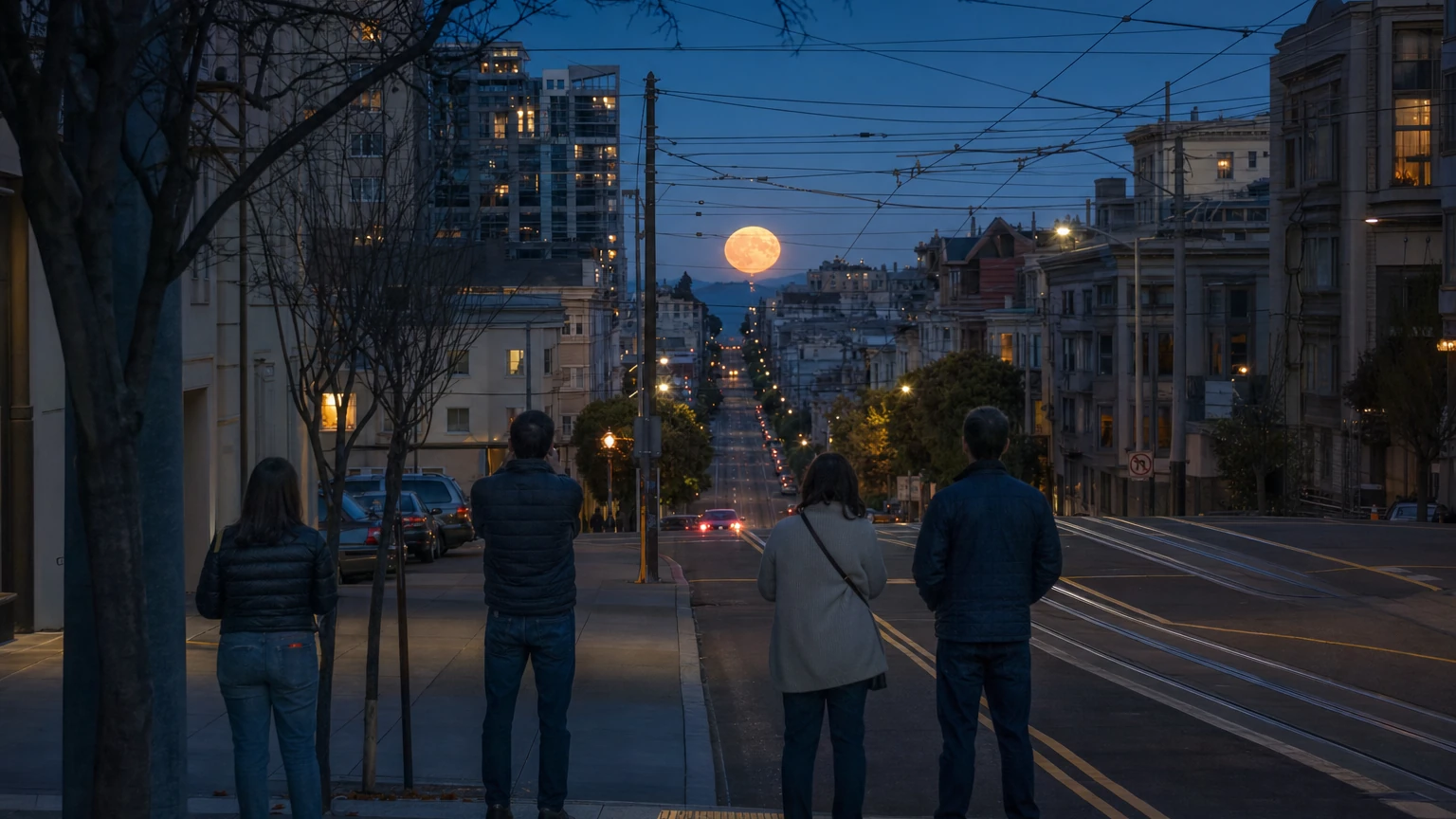
SAN FRANCISCO — California Street's famous sunrise “Henge” has a lunar counterpart lining up for Saturday evening, Sept. 26.
San Francisco's Harvest Moon rises at 6:53 p.m. at an azimuth of 82°, according to Timeanddate. That is strikingly close to the roughly 80°–81° eastward geometry associated with California Street's better-known solar Henge. Sunset follows at 7:00 p.m., leaving the low full Moon in a still-bright twilight sky if fog and buildings cooperate.
The alignment is not just theoretical. Photographer Jay Huang published a 2023 full-moon image made from California Street under the title “California Moon Henge”, describing a planned moonrise composition along the street during sunset.
What time is the Harvest Moon in San Francisco on Sept. 26?
The Moon reaches exact full phase at 9:49 a.m. PDT. It does not rise over San Francisco until 6:53 p.m., when Timeanddate puts its rising azimuth at 82°.
Sunset is at 7:00 p.m. and civil twilight ends around 7:26 p.m.. That seven-minute gap between moonrise and sunset is especially useful photographically because city details can remain visible while the Moon climbs into the eastern sky.
| Evening | Moonrise | Azimuth | California Street potential |
|---|---|---|---|
| Friday, Sept. 25 | 6:28 p.m. | 90° | Due east; well south of the strongest California Street alignment. |
| Saturday, Sept. 26 | 6:53 p.m. | 82° | Best one-night Moon Henge candidate. |
| Sunday, Sept. 27 | 7:20 p.m. | 74° | Moon has moved north of the strongest alignment. |
The Moon's rising point shifts quickly from one evening to the next, which is why Sept. 26 stands out instead of creating a broad week-long window.
Why does 82° matter on California Street?
Due east is 90°, but San Francisco's downtown street grid is rotated. Prior reporting cited in SF News Today's California Henge guide puts California Street at roughly 80° eastward, while the strongest modeled solar Henge target came when the Sun was near 81°.
That makes an 82° moonrise close enough to put the Harvest Moon into the same street-canyon geometry that produces the familiar sunrise photographs. Exact placement will still depend on where you stand, the Moon's altitude by the time it clears buildings, and the lens being used.
Where should you try to see the California Moon Henge?
California & Mason is a strong first choice for the low-rising Moon. It sits high on Nob Hill and has documented full-moon photography looking east across California Street toward the Financial District and Bay Bridge.
California & Gough is the classic long-lens solar-Henge location. It offers a much longer street corridor and stronger telephoto compression, but Nob Hill and buildings can delay when a Moon near the horizon becomes visible.
There is no guaranteed single sidewalk square. The practical choice is to arrive early, scout the eastward corridor, stay on the sidewalk and be prepared to move a block or two if a building blocks the first appearance.
Is 6:53 p.m. the best photo time?
Not necessarily. 6:53 p.m. is the official astronomical moonrise time for San Francisco. Timeanddate's figures account for refraction, but they do not model the exact buildings, hills and sightline from a particular intersection.
The Moon may not become visible from California Street until several minutes later. A practical plan is to arrive around 6:20–6:30 p.m. and keep watching through at least 7:15 p.m. That gives time to find a safe position before moonrise and stay through the period when the Moon climbs above local obstructions while twilight remains.
Why is it called the Harvest Moon?
NASA identifies the Sept. 26 full Moon as the Harvest Moon, the full Moon associated with the period around the September equinox. NASA's September skywatching guide says the Harvest Moon rises in the east shortly after sunset and appears near Saturn, with much fainter Neptune in the same general part of the sky.
The September full Moon is not a supermoon under NASA's published calendar. NASA lists the next supermoons for Nov. 24 and Dec. 24, 2026.
Will Saturn be visible?
NASA says Saturn will appear near the Harvest Moon and should be visible without optical aid once the sky darkens enough. Neptune is far fainter and requires binoculars or a telescope.
For people interested in a public telescope event before the full Moon, San Francisco Amateur Astronomers are also holding a free Presidio Moon-viewing night on Sept. 19.
What could spoil the view?
Fog, low clouds and haze. The geometry can be excellent and the eastern horizon can still disappear. Ten days out, a detailed cloud forecast would create false precision, so SF News Today will update this page closer to Sept. 26 with the latest fog, cloud and visibility guidance.
Because the alignment shifts sharply by the following evening, Sunday is not an exact substitute if Saturday is cloudy. It can still produce a beautiful near-full Moon, but not the same California Street geometry.
Do you need special eye protection?
No. Unlike a solar Henge, looking directly at the Moon is safe. A phone can capture the scene, while a longer lens produces the compressed street-and-skyline look associated with classic Henge photographs.
Stay out of the roadway
California Street is an active roadway and cable-car corridor. Use sidewalks and legal pedestrian areas, obey signals and keep tripods out of traffic lanes and cable-car tracks. Previous solar-Henge crowds have created safety problems by spilling into the intersection.
Source file